Why Music Publishing Still Matters
Behind Every Hit Song Is a Publisher
The Business, Protection, and Long-Term Stewardship Behind the Songs We Remember
By John Francis Krimsky
Founding President, Champion Music Publishers
When a song becomes a hit, the public usually sees the performer.
The singer appears onstage, in the music video, on the album cover, across social media, and in interviews. Fans recognize the voice, the image, and the personality associated with the recording.
But behind nearly every successful song is a much larger story.
Someone wrote the melody.
Someone created the lyrics.
Someone documented the ownership.
Someone registered the composition, negotiated licenses, tracked royalties, reviewed contracts, managed rights, and kept the song commercially active long after the original release campaign ended.
That work belongs to the world of music publishing.
Music publishing is one of the most important—and least understood—parts of the music business. It links creativity to copyright, ownership to opportunity, and a songwriter’s work to the many ways it can earn income over time.
A recording may introduce a song to the world.
Publishing helps give the song a future.
A Hit Song Begins Before the Recording
Listeners often use the words “song” and “recording” as though they mean the same thing.
They do not.
The song is the underlying composition: the melody, lyrics, harmony, and musical structure created by one or more songwriters.
The recording is a particular performance of that composition.
This distinction matters because one song can be recorded many times.
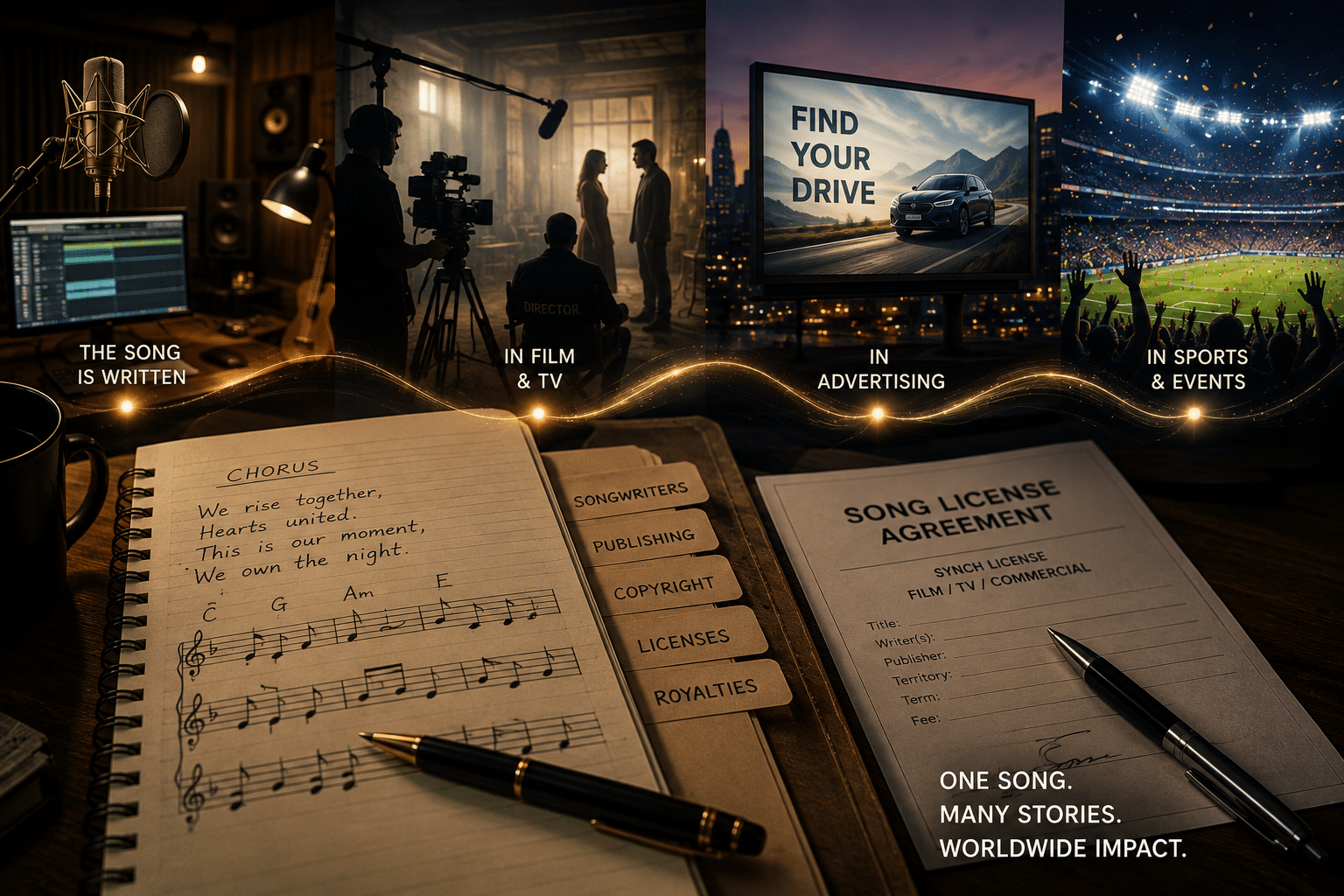
A songwriter can write a song that one artist records first, others cover later, films feature, TV shows perform, stadiums play, audiences stream worldwide, and new markets adapt.
Each recording may have a different owner.
The underlying song remains a separate intellectual property asset.
Music publishers generally work on behalf of that composition.
They help organize the rights surrounding the song so it can be protected, licensed, administered, and monetized.
Without that structure, even a successful composition can become difficult to manage.
What Does a Music Publisher Actually Do?
A music publisher may perform many different functions depending on the agreement, catalog, songwriter, and territory involved.
At its core, the publisher helps manage the business life of a song.
That work can include:
- Registering compositions with relevant organizations
- Documenting songwriter ownership shares
- Administering copyrights
- Negotiating licenses
- Collecting royalties
- Reviewing royalty statements
- Resolving ownership conflicts
- Seeking film, television, advertising, and sports placements
- Coordinating international representation
- Protecting songs from unauthorized use
- Maintaining contracts and historical records
- Preserving catalogs for future generations
Some publishers also provide creative support.
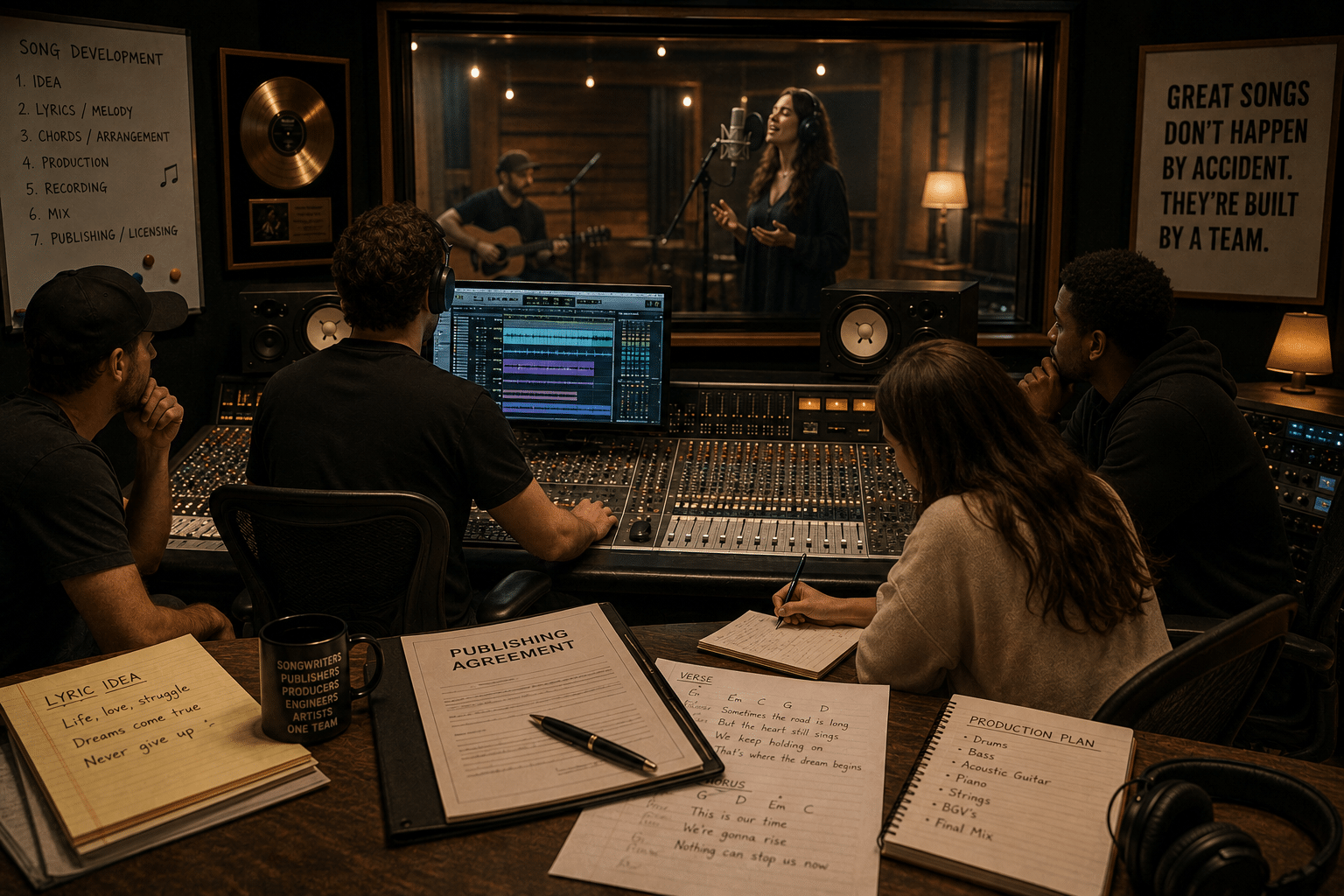
They may connect writers with artists, producers, record companies, music supervisors, advertising agencies, or other collaborators. They may organize writing sessions, pitch songs for recording, or identify older catalog works that deserve renewed attention.
Publishing therefore sits at the intersection of creativity and business.
It helps songs move from inspiration to ownership, from ownership to licensing, and from licensing to long-term value.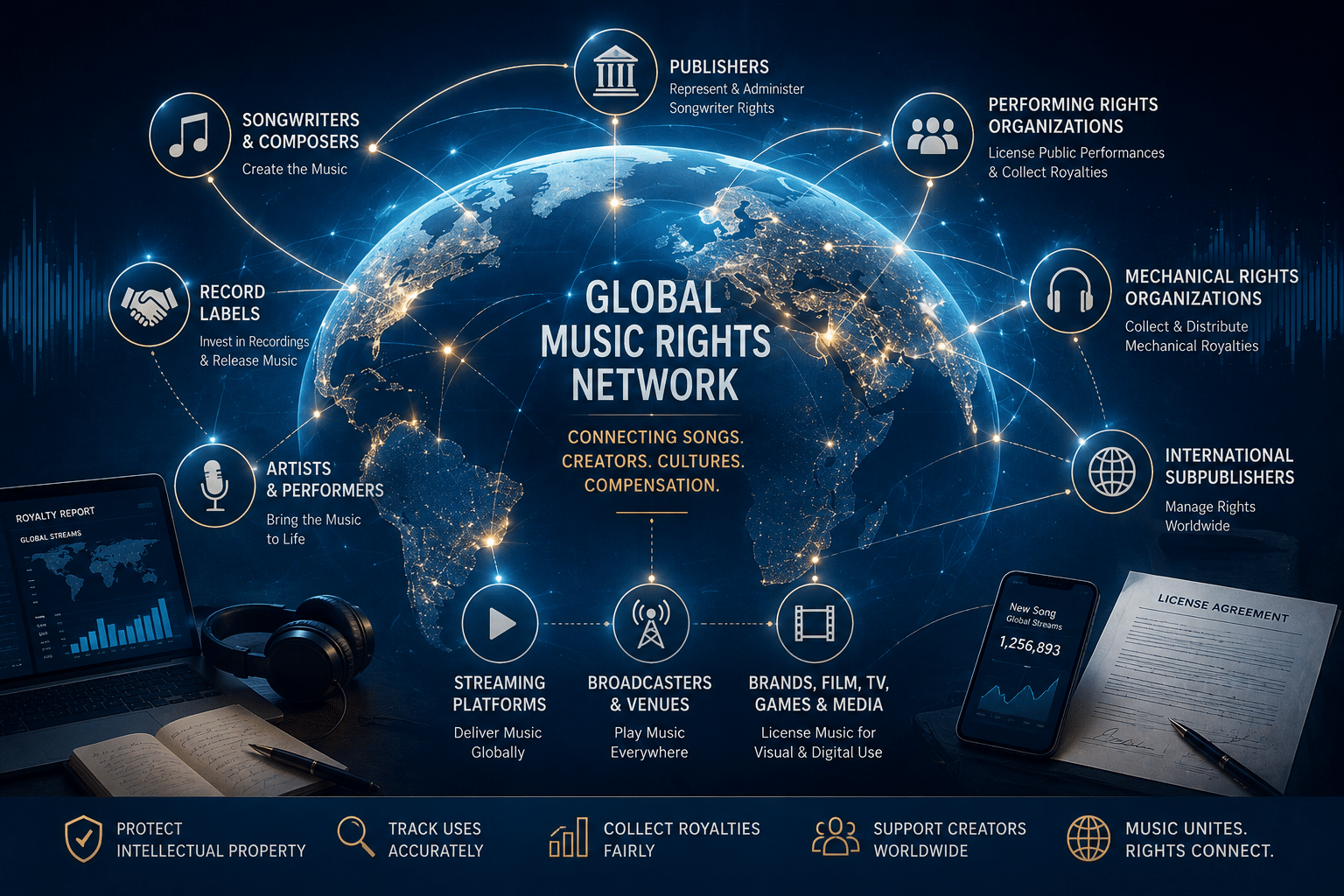
Copyright Gives the Song Its Value
A song becomes commercially meaningful because copyright allows its use to be controlled.
The owner of a composition may authorize—or refuse—certain uses of that work. Those rights make licensing possible.
When someone else wants to record your song, perform it in public, include it in a film, reprint the lyrics, adapt it, or use it in an ad campaign, they must address the copyright rights involved.
Copyright is not merely a technical legal concept.
It is the foundation of the songwriter’s business.
Without enforceable rights, a songwriter can create a valuable work yet have little control over how others copy, modify, share, or profit from it.
The publisher helps organize those rights.
That includes determining:
- Who wrote the song
- Who owns each percentage
- Which publisher controls each share
- Which territories are covered
- Which rights may be licensed
- Which approvals are required
- How income should be divided
- Which agreements govern the composition
A hit song may sound effortless.
Its ownership should never be treated casually.

Accurate Songwriting Credits Matter
Modern songs are often created by several contributors.
One person may develop the concept. Another may write the chorus. A producer may add a melody, chord progression, or lyrical section. Several artists may collaborate during the recording session.
Those contributions must be documented accurately.
A split sheet or other written agreement should identify the writers and their ownership percentages as early as possible.
When that step is neglected, problems can arise later.
A licensing opportunity may be delayed because the ownership is unclear. Royalty payments may be placed on hold. Conflicting registrations may appear in industry databases. Writers may disagree about what was promised during the session.
These problems become more serious when the song succeeds.
A song with little commercial use may draw minimal attention. But once it lands in a major ad, film, TV show, sports broadcast, or viral campaign, every ownership detail can carry real financial weight.
Good publishing begins with good records.
A publisher cannot administer what has not been documented.
The Publisher Helps the Song Earn Royalties
A successful composition can generate income from several sources.
These sources are often grouped under the general term “royalties,” but they do not all work the same way.
A song may generate:
- Public-performance royalties
- Mechanical royalties
- Synchronization fees
- Print and lyric income
- Foreign publishing royalties
- Direct-license revenue
- Cover-version income
- Adaptation fees
- Advances
- Other negotiated compensation
Each category may involve different rights, organizations, reporting systems, and payment paths.
For example, when a song is streamed on an interactive music service, it can generate both performance and mechanical royalties for the composition. A TV placement may include a synchronization fee, plus performance royalties when the show airs.
A publisher helps identify these revenue streams and make certain the composition is properly positioned to participate in them.
This requires more than waiting for checks to arrive.
It requires registration, metadata management, statement review, claim resolution, and communication with the organizations responsible for collecting and distributing the income.
A song can generate money without that money reaching the correct person automatically.
The publisher helps close the gap.
Licensing Creates New Lives for Songs
One of the most valuable functions of a publisher is helping compositions move into new settings.
A song may start with one artist and one release, but its publishing opportunities can reach far beyond the original recording.
The composition might later appear in:
- A motion picture
- A television series
- An advertisement
- A documentary
- A video game
- A sports broadcast
- A stadium presentation
- A social-media campaign
- A theatrical production
- A new recording by another artist
- A streaming series
- A political or nonprofit campaign
- A corporate presentation
Each placement can introduce the song to another audience.
A powerful scene in a film may revive interest in a catalog recording. A sports team may adopt an older song as an anthem. A television program may bring a forgotten composition back onto streaming charts.
These opportunities can generate both immediate licensing income and long-term renewed attention.
The publisher helps evaluate them.
Not every offer should be accepted.
A licensing offer might pay well, but it could place your song in a setting that clashes with your values or harms its long-term image. Another opportunity might pay less, but it could introduce your work to a new audience that truly matters.
Publishing requires commercial judgment.
The highest fee is not always the best decision.
Synchronization Has Become Increasingly Important
The use of music with visual media is known as synchronization.
A synchronization license lets you use a song in a visual project by pairing it with moving images, such as a film, TV show, advertisement, documentary, video game, or online video.
Synchronization has become increasingly important as visual content has expanded across traditional media, streaming platforms, social networks, branded entertainment, and gaming.
A successful placement can dramatically change the life of a song.
A thirty-year-old recording may suddenly reach millions of younger listeners. A new artist may gain international exposure. A songwriter may receive both a licensing fee and increased royalty income as audiences search for the music afterward.
But synchronization involves careful rights clearance.
If a production wants to use an existing recording, it may need permission for both:
- The underlying composition
- The master recording
The publisher generally represents or administers rights in the composition.
The master owner—often a record company or artist—controls the recording.
Both sides may need to approve the use.
This is one of the clearest examples of why music publishing matters. Without an organized publisher or administrator, the production may struggle to identify the person authorized to license the composition.
When rights cannot be cleared quickly, the opportunity may move to another song.
Metadata Is Now Part of the Music Business
In the digital era, a song’s information can be nearly as important as the audio itself.
Metadata identifies the composition and connects it to its creators and owners.
It may include:
- Song title
- Alternate titles
- Writer names
- Publisher names
- Ownership percentages
- Performing-rights affiliations
- Identifying numbers
- Release information
- Territory details
- Licensing restrictions
- Recording information
- Catalog and agreement data
When metadata is correct, digital systems have a better chance of matching a use to the proper rights holder.
When it is incomplete or inconsistent, income can become delayed, misdirected, or unmatched.
A song may have millions of streams.
That does not guarantee that every royalty has been identified and paid correctly.
The scale of modern music makes manual tracking impossible. Streaming platforms, broadcasters, social services, and digital distributors generate extraordinary quantities of usage data.
The industry depends on databases.
Those databases depend on accurate information.
Publishing administration is therefore no longer only about contracts and copyright registrations. It is also about maintaining clean, consistent, and interoperable data.
A Publisher Protects the Song From Misuse
Success creates opportunity.
It can also create unauthorized use.
A composition may be copied, sampled, reproduced, adapted, or placed in commercial content without proper permission. Ownership information may be registered incorrectly. A conflicting party may claim rights it does not control.
A publisher helps identify and address those problems.
Depending on the situation, that may involve:
- Contacting the user
- Requesting removal
- Negotiating a retroactive license
- Correcting registrations
- Challenging inaccurate claims
- Reviewing sample clearances
- Coordinating with legal counsel
- Pursuing unpaid royalties
- Declining inappropriate uses
- Protecting the songwriter’s contractual rights
Enforcement does not always require conflict.
The best solution may be to turn an unauthorized use into a legitimate license.
The goal is not to prevent music from circulating.
The goal is to make certain it circulates responsibly.
A good publisher makes a song easier to license correctly, not harder to use.
Publishing Is a Long-Term Business
The record business often focuses on the release cycle.
A single is launched. An album is promoted. A tour begins. Marketing activity rises and eventually moves to the next project.
Publishing operates on a longer timeline.
A composition can continue producing income and opportunity for decades.
It might be re-recorded by new artists, featured in fresh productions, rediscovered on streaming platforms, or embraced by audiences in ways the original creators never imagined.
The song may outlive the record label that released it.
It may outlive the technology on which it was first distributed.
It may even outlive the songwriter.
That long life creates responsibility.
Contracts must be preserved. Ownership changes must be recorded. Rights may be transferred or inherited. New representatives must understand the history of the catalog.
A publisher provides continuity.
The business of a song does not end when the original promotion stops.
In many cases, that is when the long-term publishing work truly begins.
Catalogs Are More Than Collections of Songs
A music catalog is a portfolio of intellectual property.
It might include a single songwriter’s lifetime of work, an independent publisher’s catalog, songs spanning multiple generations, or compositions tied to a specific label, genre, or cultural movement.
Catalogs can generate recurring income.
They may also be acquired, sold, valued, inherited, licensed, and preserved.
But their importance is not solely financial.
A catalog is also a cultural record.
It shows what people wrote about, how musical styles evolved, which voices defined an era, and how communities expressed themselves.
Preserving a catalog means preserving more than audio files.
It may require maintaining:
- Copyright documents
- Songwriting agreements
- Ownership records
- Royalty statements
- Licensing files
- Lead sheets
- Scores
- Demo recordings
- Historical correspondence
- Biographical information
- Release histories
- Photographs and artwork
- Master and reference recordings
- Documentation of transfers and inheritance
Without these materials, future generations may know the song but lose the information needed to understand, protect, or license it.
Music publishing is therefore both asset management and cultural stewardship.
Independent Songwriters Are Publishers Too
Not every songwriter works with a traditional publishing company.
Some writers self-publish. Others retain ownership while hiring an administrator. Some enter co-publishing agreements, catalog deals, or limited-term arrangements.
The structure can vary widely.
But the publishing work still exists.
A self-administered songwriter must handle many of the same responsibilities:
- Registering compositions
- Maintaining metadata
- Documenting splits
- Reviewing statements
- Responding to licensing requests
- Monitoring uses
- Tracking agreements
- Collecting income
- Preserving records
Technology has made some of this work more accessible.
It has not made it simple.
A songwriter who controls his or her own publishing should understand that ownership and administration are different functions.
Owning a copyright does not automatically mean every royalty will be collected.
The work still has to be done.
The Publisher Represents the Song When the Writer Is Not Present
A songwriter cannot personally attend every meeting, answer every licensing request, review every royalty report, or monitor every use of the composition.
The publisher represents the song when the songwriter is not in the room.
The publisher answers essential questions:
Who controls the composition?
Who must approve the use?
What rights are available?
What is the ownership split?
Which territories are covered?
What fee is appropriate?
How should the songwriters be credited?
Where should the payment be sent?
Are there restrictions on the proposed context?
What documents support the ownership claim?
This representation becomes increasingly important as the song crosses borders, platforms, industries, and generations.
The publisher carries the composition into opportunities the songwriter may never see personally.
Why Publishing Still Matters in the Streaming Era
Some observers once predicted that digital distribution would make traditional publishing less important.
The opposite has happened.
Streaming has increased the number of ways a song can be used, reported, licensed, and monetized. It has also increased the volume and complexity of the data involved.
A song may now generate activity through:
- Interactive streaming
- Noninteractive digital radio
- Short-form video
- Social platforms
- Gaming
- Livestreams
- User-generated content
- Fitness applications
- Virtual events
- International services
- Artificial-intelligence systems
- New licensing models that are still developing
Each new platform creates opportunity.
Each also creates new administrative and legal questions.
Who owns the composition?
What license applies?
How is the use measured?
Who receives the payment?
Was the song altered?
Was it used to train a system?
Was a writer’s voice, style, or identity replicated?
The future will require more publishing expertise, not less.
Artificial Intelligence Makes Rights Management More Important
Artificial intelligence is already changing music creation, catalog search, recommendation systems, content production, and rights administration.
Used responsibly, AI may help identify compositions, organize metadata, locate missing royalties, match songs with licensing opportunities, and detect unauthorized uses.
But generative systems also raise difficult questions.
Was copyrighted music used in training?
Did a system imitate a known songwriter or performer?
Who owns an AI-assisted composition?
Was the use authorized?
Should a creator be compensated when a system generates work based on that creator’s catalog?
These issues reinforce the importance of documented ownership.
A publisher cannot protect a songwriter effectively if the song’s records are incomplete.
As technology becomes more powerful, the chain of rights must become clearer.
Innovation should not erase authorship.
It should create better ways to recognize and reward it.
The Best Publishing Combines Business and Stewardship
Music publishing is sometimes discussed only in terms of royalties.
Royalties matter.
But publishing is larger than income collection.
A serious publisher must balance:
- Commercial opportunity
- Copyright protection
- Accurate administration
- Creative judgment
- Long-term reputation
- Historical preservation
- The songwriter’s intentions
- The future value of the catalog
A publisher should know not only what the song earns, but what the song means.
That understanding improves licensing decisions.
It helps identify placements that fit the composition’s emotional character. It helps avoid uses that could damage the work. It helps keep older songs visible and relevant without stripping them of their identity.
Publishing is not simply exploitation of rights.
At its best, it is stewardship of creative work.
Behind the Performer, the Songwriter Remains
A hit recording may be associated with one artist.
The composition may have been created by several people whose names the public never learns.
Those writers are the beginning of the entire process.
Without them, there is no melody to record, no lyric to perform, no chorus to stream, no anthem to play in a stadium, and no song to license into film or advertising.
The publisher helps preserve that connection.
It keeps the songwriter attached to the value created by the work.
It makes sure the song is not separated from its history, ownership, or creators.
That is why publishing still matters.
Not because the industry needs another layer of complexity.
Because creative work deserves structure, protection, and continuity.
The Song May Become Famous. The Publisher Helps It Endure.
A recording can create a moment.
A composition can create a legacy.
The public may discover a song through a performer, but the life of that song may continue through cover versions, broadcasts, films, advertisements, sporting events, streaming platforms, international adaptations, and future technologies.
Someone must maintain the rights through all those changes.
Someone must preserve the records.
Someone must answer the licensing request years later.
Someone must identify the heirs, owners, writers, administrators, and approvals.
Someone must help turn renewed attention into legitimate opportunity.
That is the work of music publishing.
The singer gives the song a voice.
The listener gives it meaning.
The publisher helps ensure it is protected, paid, remembered, and available for the future.
Championing Songwriters and Their Work
Champion Music Publishers recognizes the songwriters, composers, producers, performers, publishers, administrators, licensing professionals, and rights organizations whose work gives music its commercial and cultural life.
Behind every hit song are people whose creative contributions deserve recognition.
Behind every enduring composition should be a system capable of protecting its ownership, collecting its income, preserving its history, and preparing it for whatever opportunity comes next.
That is why music publishing still matters.
And as the ways people create, distribute, and experience music continue to expand, it will matter more than ever.
With musical best wishes,
John Francis Krimsky
Founding President
Champion Music Publishers
This article is intended for general educational and commentary purposes and does not constitute legal advice.