
Copyright, Licensing, Royalties, Administration, and the Long-Term Stewardship of Songs
Why Music Publishers Matter More Than Most Fans Realiz

My serious study of music in sport began in 2000. when I worked with the New York Yankees as partof the YankeesNets team, making sure there were no blank signs in the outfield. It was also the year of the exciting Subway Series with the NY Mets that turned into another World Series championship for the Yankees.
George Steinberger's favorite song, as you might expect, New York New York, had only one acceptable singer, Frank Sinatra. It has been played at every home game to this day and has been part of my inspiration for music in sports. It also inspired the creation of Champion Music Publishers.
Like the Boss and most ardent listeners, we experience a song through the performer.
We recognize the singer’s voice, the band’s name, the album cover, the live performance, or the recording that appears on a streaming platform. When a song becomes successful, the public naturally associates that success with the artist standing at the microphone.
But a song is more than a performance.
Before it becomes a recording, it is a composition created by one or more songwriters. After it is released, it becomes a piece of intellectual property that may be performed, streamed, recorded, licensed, broadcast, translated, sampled, synchronized with visual media, and passed from one generation to another.
Someone must keep track of who wrote it.
Someone must document who owns it.
Someone must register it with the appropriate organizations, negotiate licenses, monitor its use, collect the income it generates, protect it from unauthorized exploitation, and preserve the information that allows it to remain commercially active.
That is where the music publisher enters the story.
Most fans never see the publisher’s work. There is no publisher standing at center stage during the concert, appearing in the music video, or accepting applause after the final song.
Yet without effective publishing, even a successful composition can become difficult to license, difficult to identify, difficult to protect, and difficult to monetize.
A music publisher helps transform a song from a creative work into an organized, protected, and enduring asset.
A Song and a Recording Are Not the Same Thing
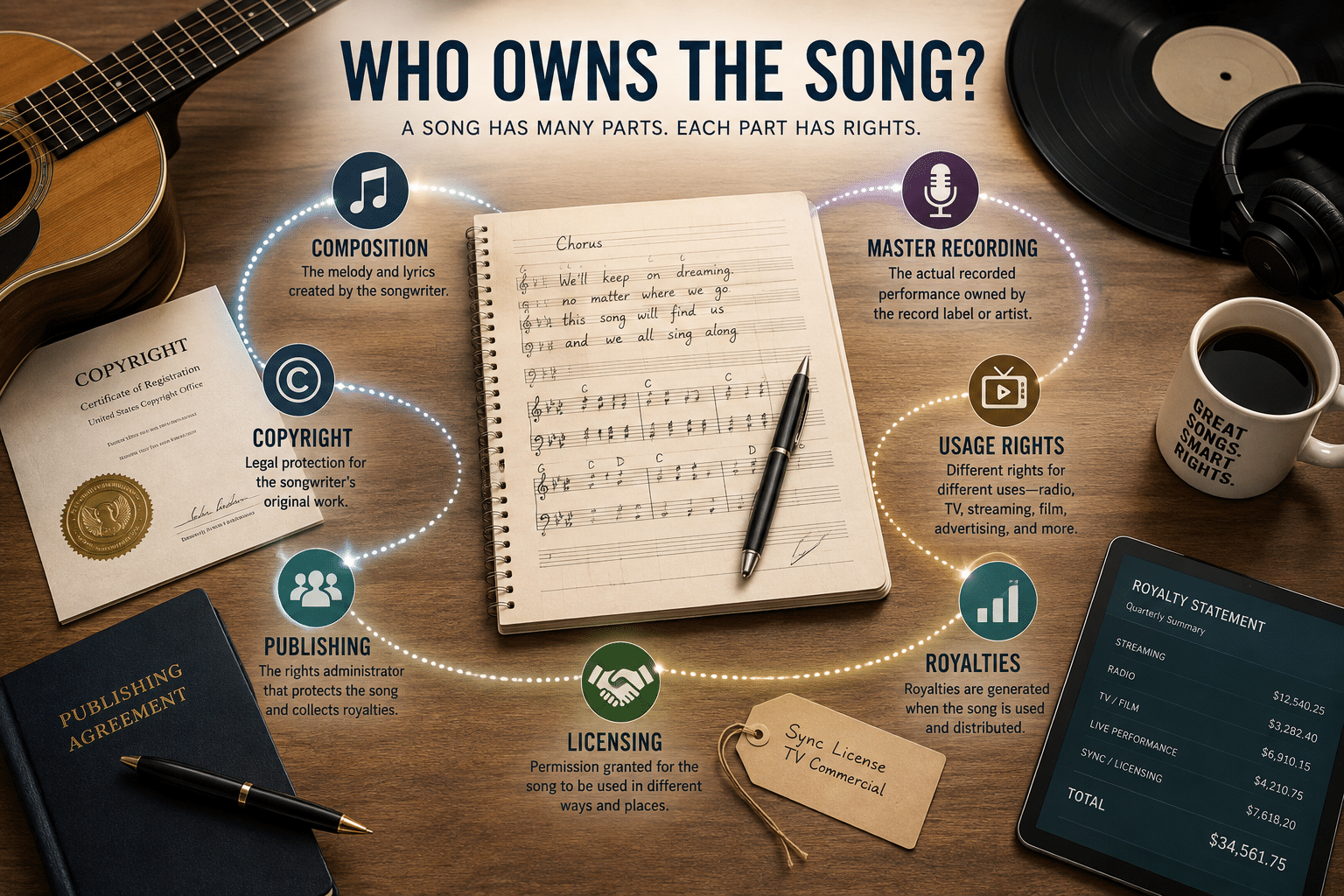
The first step in understanding music publishing is recognizing the difference between a song and a recording of that song.
Under United States copyright law, the underlying musical composition and the sound recording are separate copyrighted works.
The composition consists of the music and lyrics created by the songwriter or songwriters. The sound recording is a particular recorded performance of that composition. Copyright ownership in one does not automatically establish ownership in the other.
Consider a familiar song that has been recorded by several artists.
The words and melody may remain substantially the same, but each artist creates a different recording. There may therefore be one underlying composition and several separately owned sound recordings.
The music publisher generally works on the composition side.
The record company or master owner generally works on the recording side.
In some cases, the same person or company may control interests in both. Frequently, however, the rights are divided among several parties.
This distinction affects nearly every commercial use of music.
When a business wants to place a familiar recording in a film, advertisement, television program, documentary, video game, or promotional campaign, it may need permission involving both the composition and the master recording.
Permission to use the recording does not necessarily include permission to use the underlying song.
That is one reason music licensing can become complicated. What sounds like one unified piece of music to the listener may involve separate copyrights, separate owners, separate representatives, and separate negotiations.
Copyright Is the Foundation
Music publishing begins with copyright.
Copyright protects original works of authorship once they are fixed in a tangible form. For a songwriter, that may mean writing down the lyrics, recording a demonstration, creating a digital file, or otherwise capturing the composition in a sufficiently permanent form.
Copyright gives the owner a collection of exclusive rights that may include the ability to reproduce the work, distribute it, prepare derivative works, perform it publicly, and authorize others to engage in those activities.
These rights give a composition commercial value.
A song is not valuable merely because people enjoy it. It is valuable because its use can be controlled and licensed.
If anyone could reproduce, distribute, modify, broadcast, or commercially exploit a composition without permission, the songwriter would have little ability to participate in the economic value created by the work.
Copyright establishes the legal foundation.
Publishing turns that foundation into an operating system.
A publisher helps determine who owns which percentage of a composition, which rights are included in an agreement, where the composition has been registered, who may authorize a particular use, and where the resulting royalties should be paid.
The Publisher Helps Establish the Chain of Ownership
Songs are often created collaboratively.
One person may write the lyrics. Another may compose the melody. Several band members may develop the arrangement together. A producer may contribute a section significant enough to earn a writing interest.
Each contributor may own a percentage of the composition.
Those percentages must be documented.
A song with two writers does not necessarily have a 50-50 ownership division. The writers may agree to any division that accurately reflects their arrangement. A composition with several contributors may have an even more complex ownership structure.
Problems arise when these decisions are not documented clearly.
Writers may remember the collaboration differently. A contributor may believe a percentage was promised verbally. A later publisher may receive incomplete information. A licensing request may arrive before the ownership disagreement has been resolved.
The absence of reliable documentation can prevent a valuable opportunity from moving forward.
A music supervisor working under a deadline may not have time to resolve disputed ownership. If the rights cannot be cleared confidently, the production may simply select another song.
Good publishing administration begins with accurate information:
- The legal names of the writers
- Their professional or performing names
- Their ownership percentages
- Their performing-rights affiliations
- Their publishing entities
- Their identifying numbers
- The agreements governing the composition
- The territories covered
- The parties authorized to issue licenses
- Any samples or preexisting material incorporated into the song
This information is not administrative clutter.
It is the infrastructure that allows the composition to earn money.
Administration Is Where Value Is Often Won or Lost
Publishing administration is the ongoing process of managing the business details surrounding a composition.
It may include registering songs, maintaining ownership records, reviewing royalty statements, issuing licenses, collecting payments, coordinating with foreign representatives, resolving conflicting claims, tracking contractual rights, and making certain that changes are reflected across multiple industry databases.
This work may not look glamorous, but it can determine whether money reaches the correct creators.
The modern music economy generates enormous quantities of data. Streaming services process vast numbers of uses. Broadcasters play music around the clock. Venues, digital platforms, and commercial productions rely on extensive catalogs.
A payment system can only work properly when a use can be matched to the correct composition and the correct rights holder.
The Mechanical Licensing Collective, for example, receives usage data and royalties from eligible digital services operating under the United States blanket mechanical license. It then matches reported streams and downloads to registered songs, calculates the royalties owed, and distributes payments to eligible publishers, administrators, collective organizations, and self-administered writers.
If the song data is missing, incomplete, duplicated, or inconsistent, the matching process becomes more difficult.
The song may have been streamed.
The royalty may have been generated.
But unless the use is connected to the correct ownership record, the payment may not arrive where it belongs.
This is why publishing administration matters more than many creators realize.
It is possible to own a right and still fail to collect all the income generated by that right.
Registration Is Not a One-Time Event
A common misunderstanding is that a song is registered once and the administrative work is finished.
In reality, music data may need to be delivered to several organizations and updated throughout the life of the composition.
A publisher may register or maintain information with:
- The U.S. Copyright Office
- Performing-rights organizations
- The Mechanical Licensing Collective
- Foreign societies and subpublishers
- Licensing databases
- Collection organizations
- Digital-rights and royalty platforms
- Internal catalog-management systems
These organizations do not all perform the same function.
Copyright registration provides a public record and important legal benefits. Performing-rights organizations license and collect for certain public performances. The MLC administers eligible digital audio mechanical royalties in the United States. Foreign societies and subpublishers may handle rights and income in other territories.
No single registration necessarily covers every royalty stream.
Publishing administration requires an understanding of how these systems interact.
It also requires attention to change.
A writer may move from one publisher to another. An ownership interest may be transferred. A catalog may be acquired. A songwriter may reclaim certain rights under applicable law. A company may merge or change its name. An heir may inherit an interest.
The underlying song may remain the same while the rights surrounding it evolve.
A responsible publisher maintains the record.
Licensing Allows Music to Travel
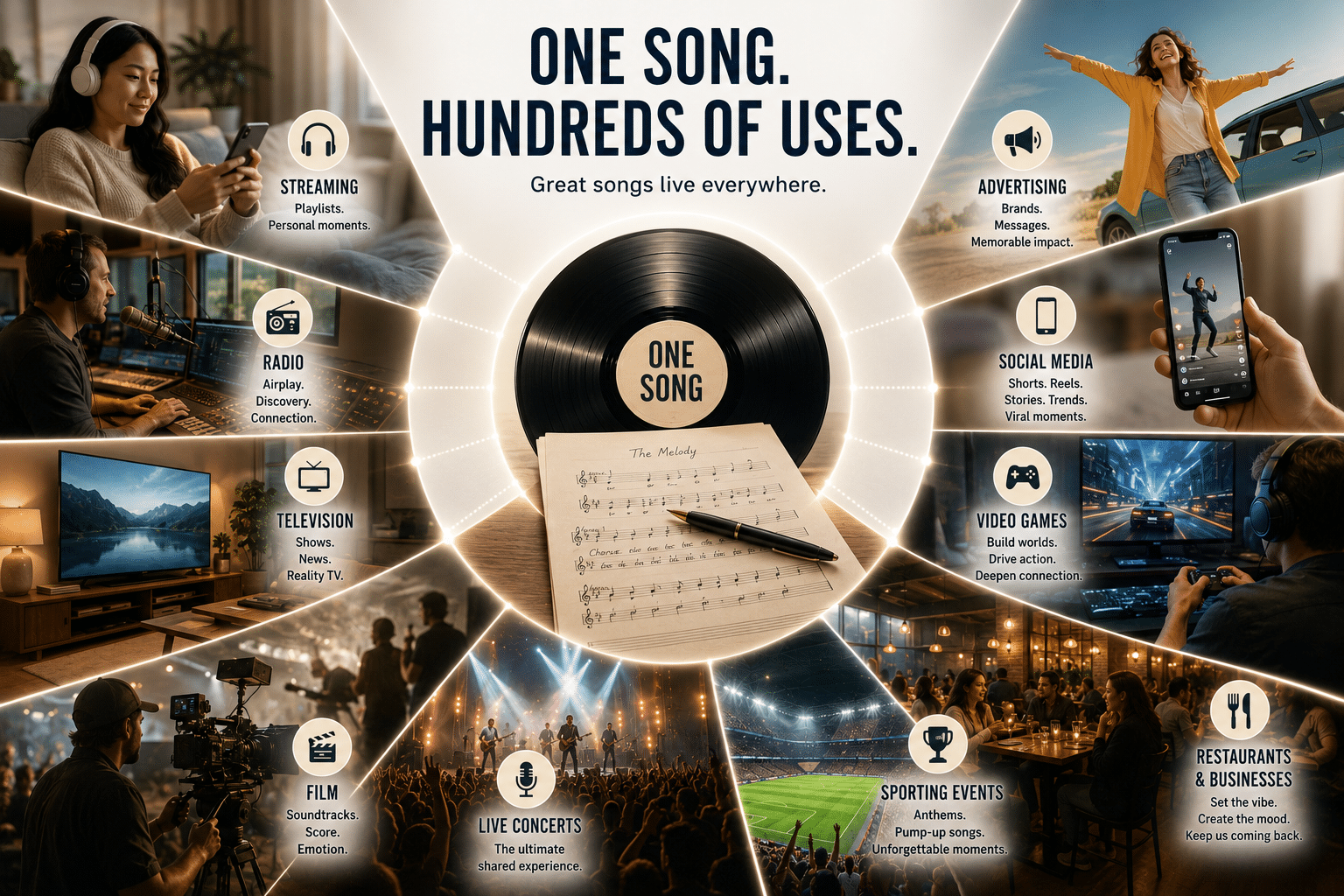
Licensing is one of the most visible ways a publisher creates value.
When another party wants to use a composition, the publisher may evaluate the request, confirm the rights it controls, negotiate terms, issue permission, collect the fee, and account to the songwriter or other entitled parties.
The nature of the license depends on the use.
Public Performance
A musical composition is publicly performed when it is played or performed in qualifying public settings, including many broadcasts, venues, businesses, and digital services.
Performing-rights organizations emerged in part because licensing each public performance individually would be impractical. They provide collective or blanket licensing solutions and distribute royalties to affiliated songwriters and publishers based on reported and measured uses.
Mechanical Use
Mechanical royalties are associated with the reproduction and distribution of musical compositions through formats that may include physical recordings, downloads, and eligible interactive streams.
In the United States, The MLC administers the blanket digital audio mechanical license for eligible streaming and download services and distributes collected royalties to qualifying rights holders.
Synchronization
A synchronization license permits a composition to be timed with visual media.
This may include:
- Motion pictures
- Television programs
- Advertisements
- Documentaries
- Video games
- Online videos
- Sports highlights
- Corporate presentations
- Political advertising
- Social-media campaigns
A synchronization request is often negotiated directly rather than handled through a blanket license.
The publisher evaluates the proposed use, duration, territory, term, platform, prominence, context, and commercial value of the placement.
The owner of the sound recording may separately negotiate a master-use license when an existing recording will be used.
Print, Lyrics, and Other Uses
Compositions may also be licensed for sheet music, lyric reproduction, educational products, theatrical uses, translations, arrangements, and other adaptations.
Each use presents its own questions.
What rights are requested?
For how long?
In which countries?
On which media?
Is the use exclusive?
Will the song be changed?
How prominently will it appear?
Will the context damage the reputation or long-term value of the work?
A publisher must consider more than the immediate fee.
A license can create exposure and renewed commercial activity. It can also associate a composition with a product, cause, message, or context that the songwriter never intended.
Good licensing is both a revenue function and a stewardship function.
Royalties Are Not One Single Payment
Fans often hear that a songwriter earns “royalties” and assume all royalty income comes from one source.
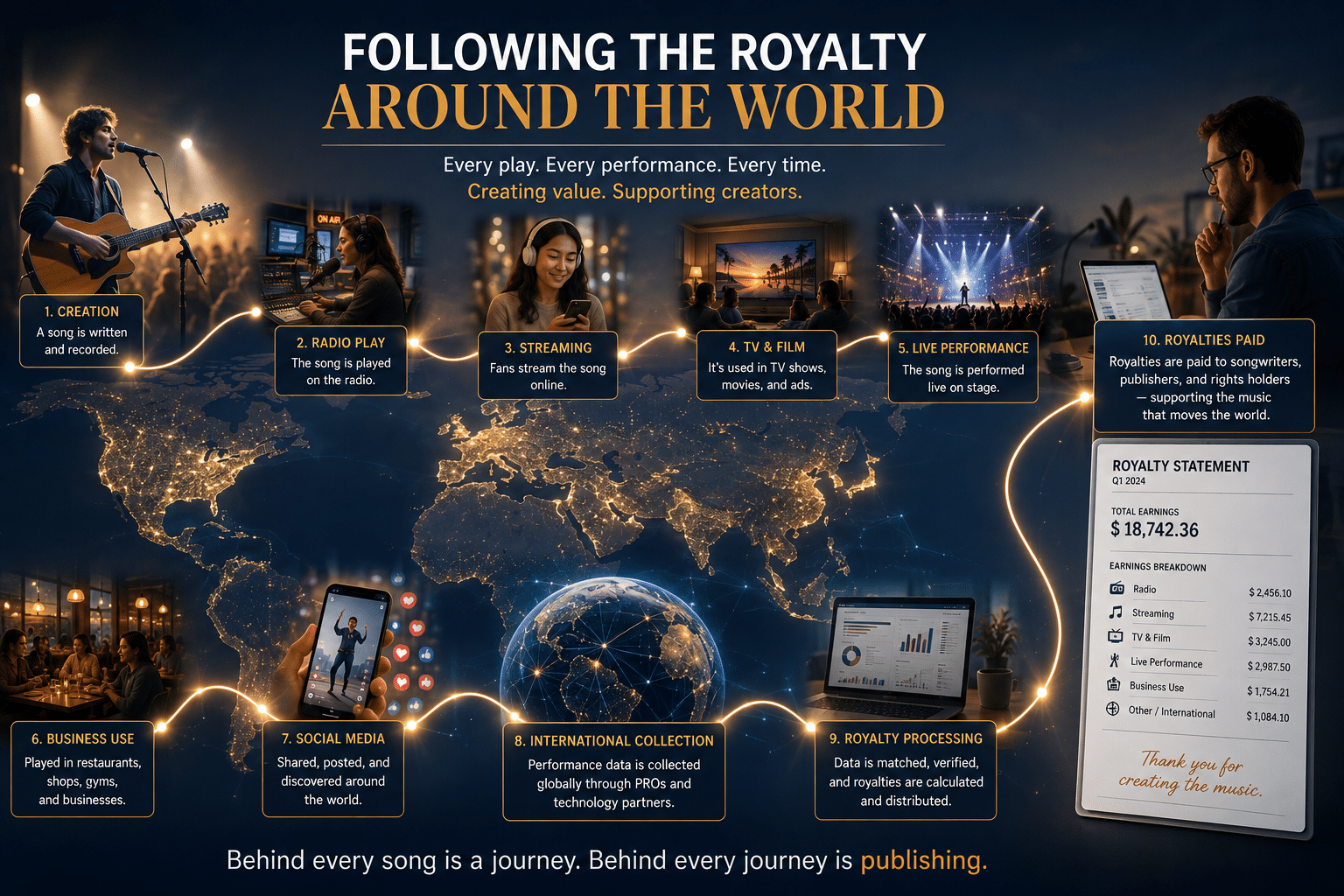
In reality, a composition may generate several forms of revenue.
Depending on the work, territory, contracts, and use, publishing income may include:
- Public-performance royalties
- Mechanical royalties
- Synchronization fees
- Print and lyric income
- Foreign publishing income
- Adaptation and arrangement fees
- Direct licenses
- Advances
- Settlement income
- Other negotiated uses
Different organizations may collect different categories.
A performing-rights organization may collect for qualifying public performances. The MLC may collect eligible United States digital audio mechanical royalties. A publisher may negotiate a synchronization license directly. A foreign subpublisher or society may collect in another territory.
Each revenue stream follows its own path.
The publisher’s role is to understand those paths and make certain that the composition is positioned to participate in them.
This is one reason metadata matters so much.
A small error in a title, ownership share, writer identifier, publisher name, or catalog record can disrupt matching. One organization may show an outdated publisher. Another may list an incomplete ownership share. A foreign territory may lack the information needed to send payment home.
A publisher investigates these gaps.
The work is not merely collecting checks.
It is finding income that might otherwise remain unidentified, unmatched, delayed, or unpaid.
The Difference Between Collecting and Creating Opportunity
Royalty collection is only part of publishing.
A proactive publisher also looks for ways to extend the commercial life of a composition.
That may involve presenting songs for:
- Film and television placements
- Advertising campaigns
- Sports and entertainment events
- Cover recordings
- International adaptations
- Catalog compilations
- Digital content
- Reissues
- Tribute projects
- Historical documentaries
- New artist collaborations
A well-managed catalog can produce opportunities many years after its original release.
A song that was overlooked when first recorded may later become ideal for a movie scene. An older composition may find a new audience through a television program. A sports team may adopt an existing recording as an anthem. A viral video may send listeners back to a catalog that had been commercially quiet.
The publisher helps keep the door open.
This is particularly important for songs whose writers are no longer actively promoting them. Without ongoing stewardship, a composition can disappear into incomplete records, outdated contact information, unresolved ownership questions, or neglected registrations.
A publisher gives the catalog continuity.
Catalog Preservation Is Cultural Preservation
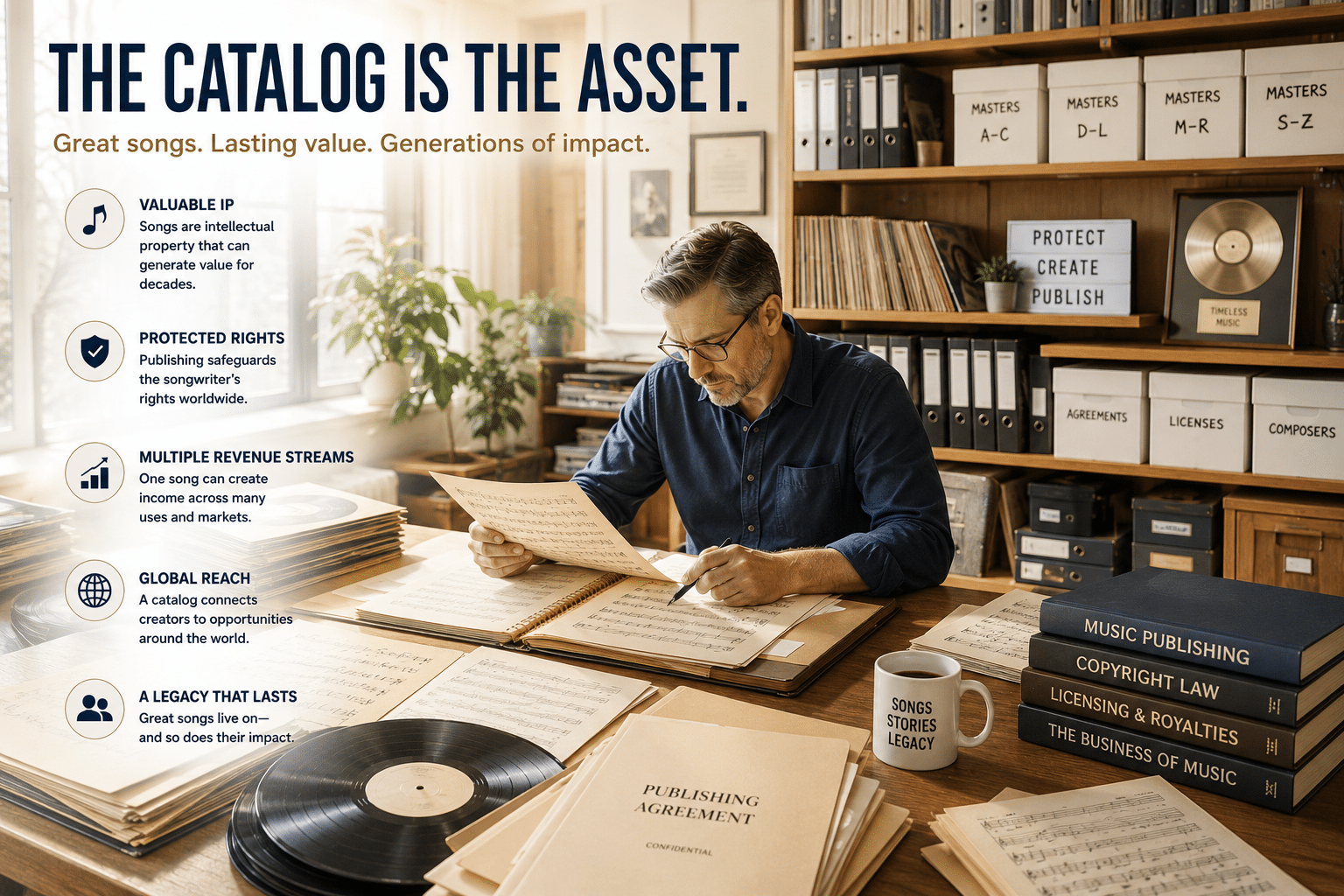
Music catalogs are often discussed as financial assets.
They are.
A strong catalog can generate recurring income through licensing, performances, streaming, recordings, and new uses. It may be acquired, sold, inherited, valued, and administered across generations.
But a music catalog is also a cultural archive.
It contains the creative work of songwriters, composers, performers, and producers. It may reflect a particular era, community, genre, label, or artistic movement.
Preserving a catalog therefore requires more than retaining audio files.
The publisher must preserve the information that gives those works legal and commercial meaning.
That may include:
- Original agreements
- Copyright registrations
- Writer and ownership records
- Split sheets
- Licensing history
- Royalty statements
- Correspondence
- Lead sheets and scores
- Demonstration recordings
- Original masters or reference copies
- Photographs and artwork
- Biographical information
- Release histories
- Alternate titles
- Territory information
- Documentation of transfers and inheritance
Without this material, future generations may know that a song exists while lacking the information needed to license, protect, or understand it.
Catalog preservation protects both value and history.
It allows a work to be rediscovered without losing its chain of ownership.
It allows heirs to understand what they inherited.
It allows documentary producers, historians, artists, and licensees to locate the people authorized to speak for the work.
It allows the songwriter’s contribution to remain visible.
A Catalog Must Be Maintained Like Any Serious Asset
A valuable catalog cannot be managed casually.
Ownership records should be reviewed. Agreements should be organized. Registrations should be checked. Royalty statements should be reconciled. Missing works should be identified. Conflicting claims should be investigated.
The publisher should also understand the catalog creatively.
Which songs are suitable for sports?
Which work could support a documentary?
Which composition has a strong holiday theme?
Which song might appeal to a new recording artist?
Which recordings are historically significant?
Which lyrics require careful contextual review?
Which works have never been promoted properly?
Catalog stewardship combines administrative discipline with creative judgment.
A database alone cannot identify every opportunity. A publisher must know the songs.
That familiarity is one of the differences between passive ownership and active publishing.
Songs Can Outlive Their Original Agreements
Catalog stewardship becomes particularly important as rights move across decades.
Copyright interests may be assigned, licensed, inherited, acquired, or otherwise transferred. The Copyright Act permits ownership to be transferred in whole or in part, and copyright interests may pass through a will or applicable inheritance law.
United States law also provides authors or their heirs with termination rights under certain circumstances, allowing qualifying grants of copyright transfers or licenses to be terminated during specified statutory windows. The applicable requirements depend on factors including when the grant was made and when the work was created or copyrighted.
These rules are complex and should be handled with qualified legal guidance.
Their existence nevertheless reinforces an important point: music publishing is a long-term business.
A contract signed decades earlier may still affect ownership today. A songwriter’s heirs may become important decision-makers. A catalog acquisition may require review of historical agreements, reversions, notices, and territory limitations.
Songs can outlive companies, technologies, formats, and even the people who created them.
The publisher helps maintain continuity across those changes.

Publishers Protect Songs From Unauthorized or Harmful Uses
Not every use of music creates value.
Some uses may be unauthorized. Others may be legally permitted under a particular arrangement but commercially damaging. A composition may be placed in a context that conflicts with the songwriter’s reputation, beliefs, or intended audience.
A publisher may help monitor uses and determine when action is necessary.
That action may include:
- Requesting removal of unauthorized content
- Investigating unlicensed commercial use
- Correcting ownership claims
- Challenging improper registrations
- Addressing unpaid royalties
- Reviewing sample usage
- Enforcing contract rights
- Negotiating retroactive permission
- Coordinating with counsel
- Declining inappropriate licensing requests
The strongest form of protection is often prevention.
Clear documentation, accurate registrations, organized contracts, and identifiable representatives make it easier for legitimate users to obtain permission before problems arise.
A publisher should not make a song difficult to license.
It should make the song easy to license correctly.
Independent Songwriters Need Publishing Knowledge Too
Not every songwriter signs with a traditional publishing company.
Some creators administer their own works. Others use independent administrators, collection services, attorneys, managers, or hybrid arrangements.
The availability of self-administration tools does not eliminate the need for publishing knowledge.
A self-administered writer is still acting as a publisher.
That person must understand registrations, metadata, split documentation, royalty sources, licensing requests, contracts, and long-term recordkeeping.
The MLC allows eligible self-administered songwriters to become members and collect qualifying United States digital audio mechanical royalties directly. That is an important resource, but it does not automatically replace every other publishing function.
A songwriter may still need to address public-performance registrations, synchronization opportunities, foreign collections, copyright records, licensing negotiations, catalog promotion, and administrative conflicts.
Technology has made self-administration more possible.
It has not made music publishing simple.
The Publisher Represents the Song When the Songwriter Is Not in the Room
Perhaps the clearest way to understand a publisher is to think of the publisher as the continuing representative of the composition.
The songwriter cannot attend every licensing meeting.
The songwriter may not know when a broadcaster, filmmaker, advertiser, team, venue, or digital platform wants to use the work.
The songwriter may not be available decades later when the composition is rediscovered.
The publisher remains.
It answers the questions:
Who controls this song?
Can it be licensed?
What rights are available?
Who must approve the use?
What terms are appropriate?
Where should the payment go?
How should the creators be credited?
What documentation supports the ownership claim?
A good publisher does not replace the songwriter’s voice.
It carries that voice into places the songwriter cannot personally reach.
Why Music Publishers Matter to Fans
Fans may never read a publishing agreement or examine a royalty statement.
They still benefit from publishing.
Publishing helps make it possible for songs to appear in movies, television programs, advertisements, video games, stadiums, documentaries, streaming services, and new recordings.
It helps older music remain available.
It helps identify the people who created the work.
It helps songwriters receive compensation when their compositions generate value.
It helps preserve catalogs that might otherwise disappear.
It helps future artists legally record, reinterpret, and introduce songs to new audiences.
When publishing works properly, the listener may never notice it.
The song simply appears where it belongs.
The creator is credited.
The rights are cleared.
The payment is processed.
The catalog survives.
Invisible work is still essential work.
The Long Life of a Song
A recording campaign may last several months.
A successful composition can last for generations.
It may begin as a handwritten lyric, a melody played at a piano, or a demonstration recorded in a small studio. It may later be performed by several artists, placed in a film, played at a stadium, streamed millions of times, or rediscovered decades after its creation.
At every stage, someone must preserve the connection between the song and the people entitled to speak for it.
That is the deeper purpose of music publishing.
It is not simply the collection of royalties.
It is the stewardship of creative work.
A publisher protects the composition’s ownership, maintains its records, administers its rights, pursues appropriate opportunities, preserves its history, and helps ensure that the value created by the song returns to the people who made it possible.
The performer gives the song a voice.
The audience gives it a life.
The publisher helps give it a future.
Championing the Songs and the People Who Create Them
Champion Music Publishers recognizes the songwriters, composers, producers, performers, publishers, administrators, licensing professionals, and rights organizations whose work allows music to move legally and responsibly through the world.
Their efforts remind us that a song is not merely content.
It is a creative achievement.
It is intellectual property.
It is a commercial asset.
It is part of our cultural history.
And when properly protected and administered, it can continue connecting creators and audiences for generations.
With musical best wishes,
John Francis Krimsky
Founding President
Champion Music Publishers
This article is intended for general educational purposes and does not constitute legal advice. Copyright ownership, licensing, royalty collection, and contractual rights vary by jurisdiction and individual circumstances.