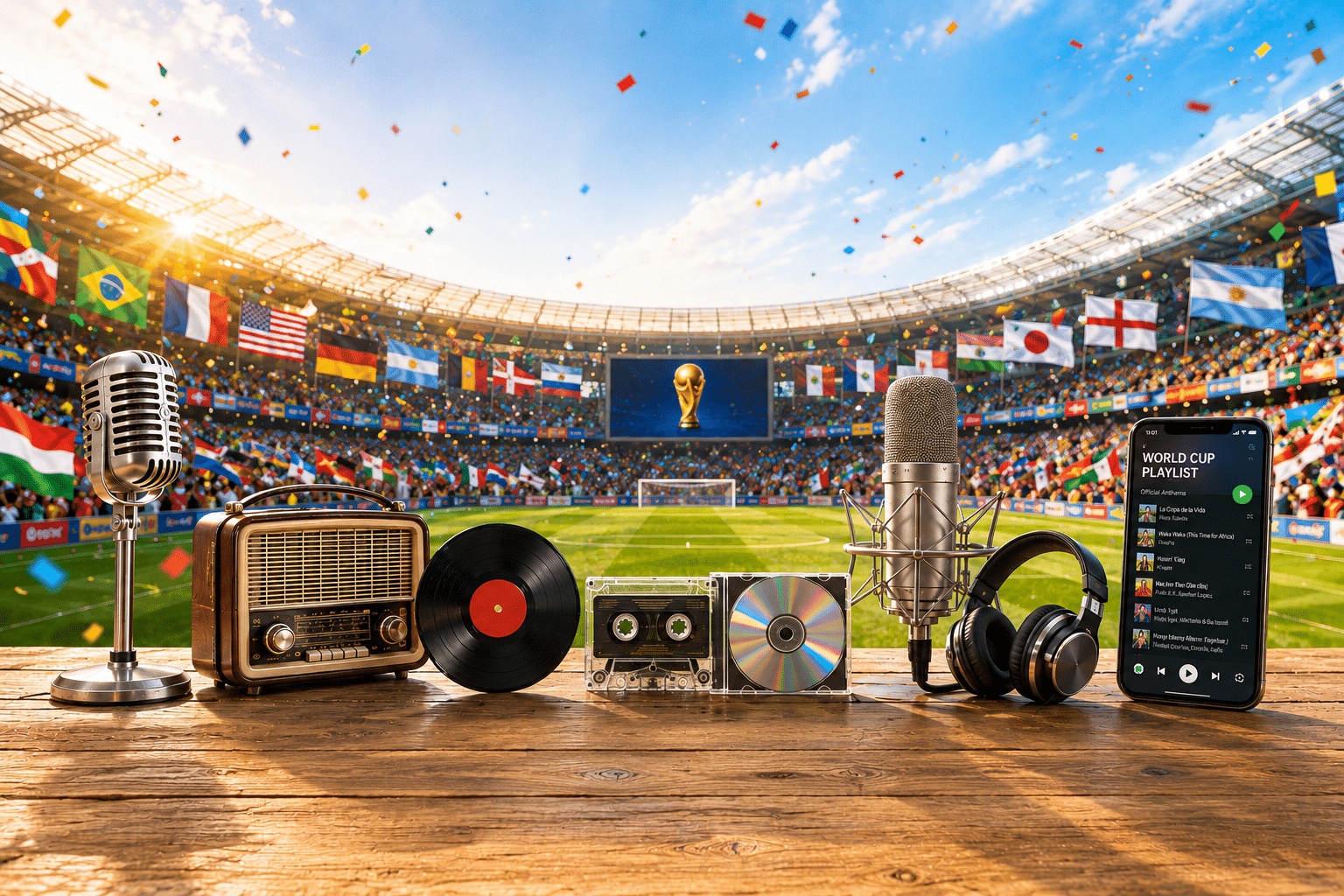
From Broadcast Themes and Stadium Anthems to a Global Streaming Experience
How Music Became the Soundtrack of the FIFA World Cup
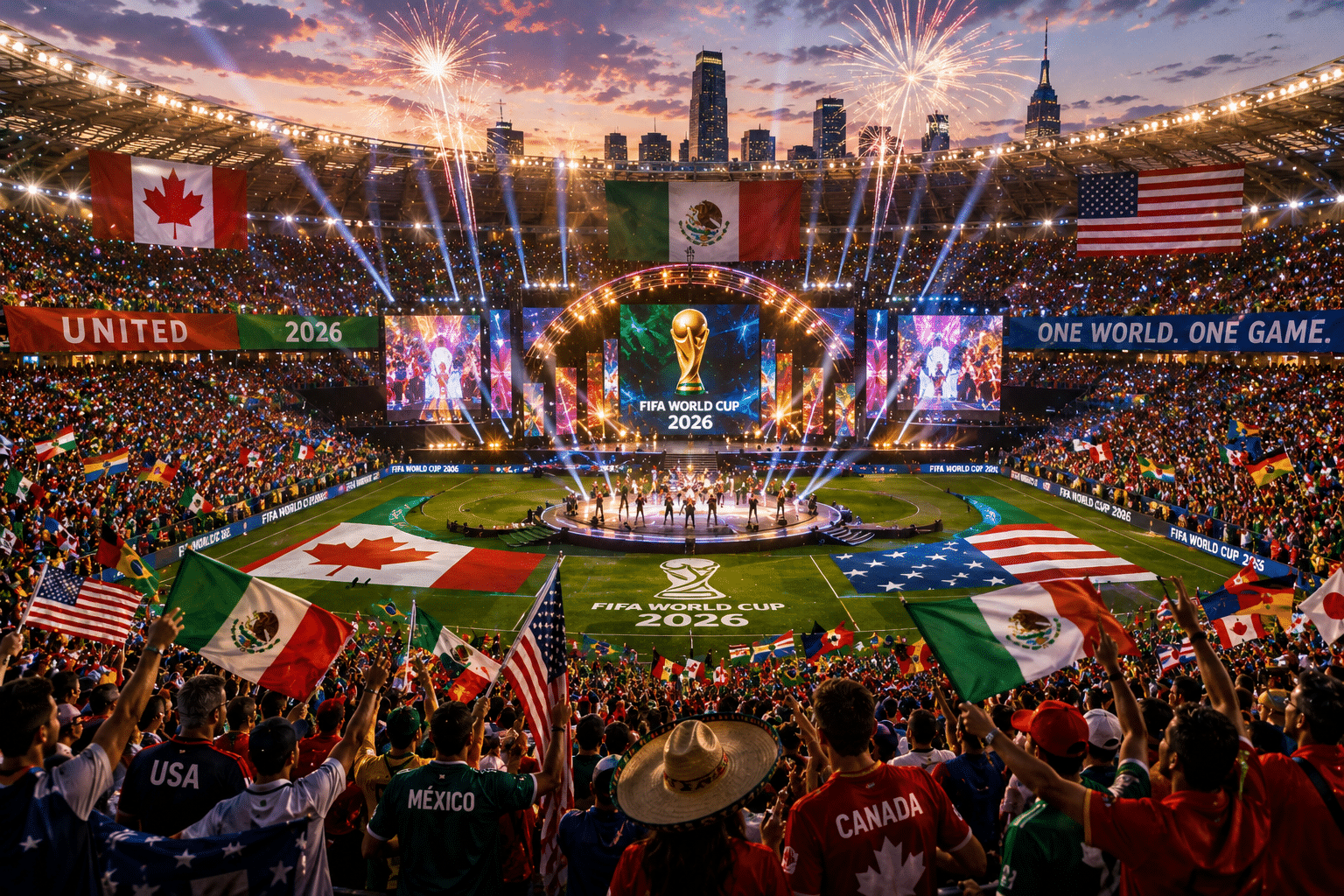
The FIFA World Cup has always been about more than the matches played on the field. It is a global cultural event shaped by national pride, unforgettable performances, shared celebrations, and the stories created when people from different countries come together around the same game.
Music has become one of the most important parts of that experience.
Long before the opening whistle, songs begin building anticipation for the tournament. They appear in television promotions, online videos, opening ceremonies, stadium celebrations, advertisements, playlists, and social-media posts. During the competition, certain melodies become inseparable from the goals, victories, disappointments, and emotional moments experienced by millions of supporters.
After the tournament ends, those same songs often remain.
A great World Cup song can instantly return a listener to a particular summer, host nation, team, or championship moment. That ability to preserve emotion is one reason the history of FIFA World Cup songs has become such an important part of the tournament’s larger legacy.
The Early Development of World Cup Music
The relationship between football and music existed long before FIFA developed a formal global music program. Supporters have always sung in stadiums. National teams have always entered the field accompanied by national anthems. Local musicians have always written songs celebrating players, countries, and competitions.
In the earlier decades of the World Cup, however, tournament music was largely local and broadcast-driven. Songs might be written for the host country, performed during a ceremony, or used by television networks to introduce their coverage. The music helped establish the atmosphere surrounding the event, but distribution remained limited by the technology of the period.
Before international cable television, music video channels, digital downloads, and streaming services, a tournament song might become widely known in the host country while remaining relatively unfamiliar elsewhere. Radio, physical recordings, television broadcasts, and live performances were the principal methods of reaching audiences.
FIFA identifies the 1966 World Cup in England and the song associated with the tournament’s first official mascot, “World Cup Willie,” as the beginning of the modern tradition of official World Cup songs. Over time, the official music program became an increasingly significant part of how the tournament was presented and remembered.
That development reflected a growing realization: the World Cup needed not only a visual identity, but a musical one.
Why Every World Cup Develops Its Own Musical Identity
Every World Cup has a different personality.
The identity of a tournament is influenced by the host nation, local traditions, participating teams, stadiums, ceremonies, visual branding, and historical context. Music brings these elements together in a form that audiences can immediately recognize and emotionally understand.
A tournament hosted in Latin America will naturally draw from a different musical vocabulary than one staged in Europe, Asia, Africa, or the Middle East. Local rhythms, instruments, languages, and performance traditions help connect the international competition to the culture of its host.
At the same time, the World Cup is not solely a local event. Its music must speak to an international audience.
That creates an unusual creative challenge. An official World Cup soundtrack must represent the character of the host while remaining accessible to listeners across many countries, cultures, and languages. The strongest World Cup songs do not erase local identity in pursuit of global popularity. They find a way to make that identity understandable and exciting to the wider world.
This balance between local character and international appeal is one reason World Cup music frequently relies on collaboration. Artists, songwriters, producers, publishers, record companies, broadcasters, and tournament organizers work together to create music that can function across multiple settings.
A World Cup song may need to succeed as:
- A radio and streaming release
- A stadium anthem
- A television theme
- A live ceremonial performance
- A promotional soundtrack
- A social-media audio clip
- A lasting cultural memory
Few musical projects are asked to perform so many roles at the same time.
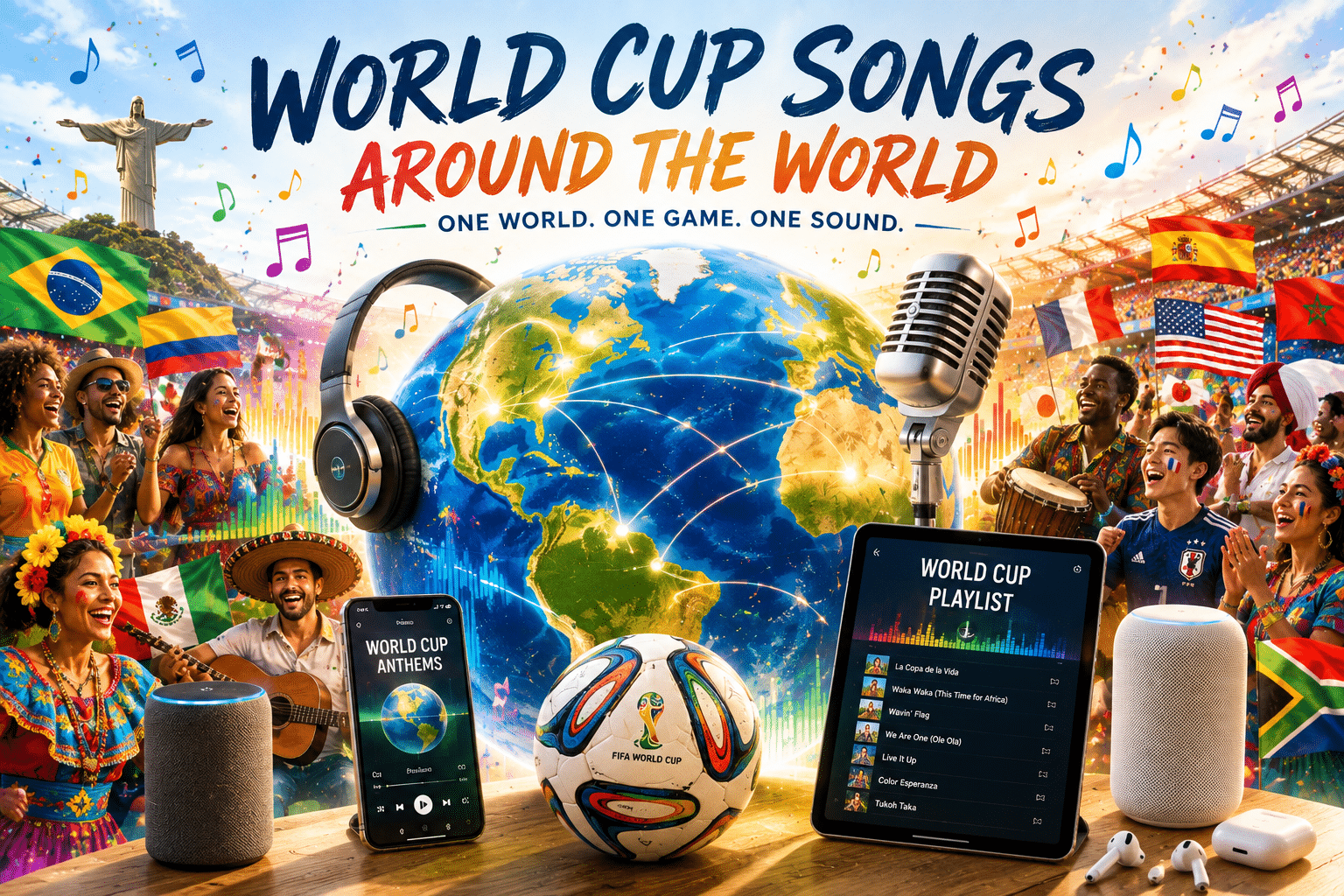
The Rise of the Modern World Cup Anthem
By the late twentieth century, the World Cup song had begun evolving from a ceremonial element into a major international release.
Italy’s 1990 tournament produced “Un’estate italiana,” performed by Edoardo Bennato and Gianna Nannini. The song captured both the grandeur of the event and the emotional character of the host country. It remains closely associated with that tournament and is still remembered by many supporters as one of the defining songs in World Cup music history.
The United States hosted the competition in 1994, with “Gloryland” performed by Daryl Hall with Sounds of Blackness serving as the official song. Four years later, the musical possibilities of the World Cup expanded dramatically.
Ricky Martin’s “La Copa de la Vida,” released for France 1998, became one of the most important turning points in the history of FIFA World Cup songs. FIFA recognizes it as the official song of the 1998 tournament, where Martin performed it at the Stade de France.
The song did not remain confined to football coverage. It reached radio stations, music television, concert stages, clubs, award shows, and audiences far beyond the traditional football world.
“La Copa de la Vida” demonstrated that an official tournament song could become a genuine international pop hit. It could promote the World Cup while also building its own life in popular culture.
That success changed expectations. The World Cup song was no longer simply background music for a sporting event. It could be a major entertainment property of its own.
World Cup Music in the Global Television Era
As television distribution expanded, World Cup music became more visible and more carefully integrated into the tournament’s presentation.
Anastacia performed “Boom” as the official song for the 2002 World Cup in Korea and Japan, while composer Vangelis created an official anthem incorporating musical elements associated with the two host countries. In 2006, “The Time of Our Lives,” performed by Il Divo and Toni Braxton, added a sweeping and ceremonial tone to the tournament in Germany.
These releases illustrate an important distinction in World Cup music: an official song and an official anthem may serve different purposes.
A song is generally structured for popular consumption, radio play, and audience participation. An anthem may be more ceremonial, orchestral, or closely connected to tournament branding. In practice, both contribute to the larger musical identity of the competition.
Television played a decisive role in this era. Broadcasters repeatedly used tournament music in introductions, highlight packages, advertisements, and closing sequences. Repetition allowed a song to become attached to the images viewers saw throughout the competition.
This created a powerful form of emotional association.
When audiences repeatedly hear the same music alongside dramatic goals, national celebrations, and scenes from the host country, the song becomes part of the memory of those events. Years later, hearing only a few seconds can bring the tournament back to life.
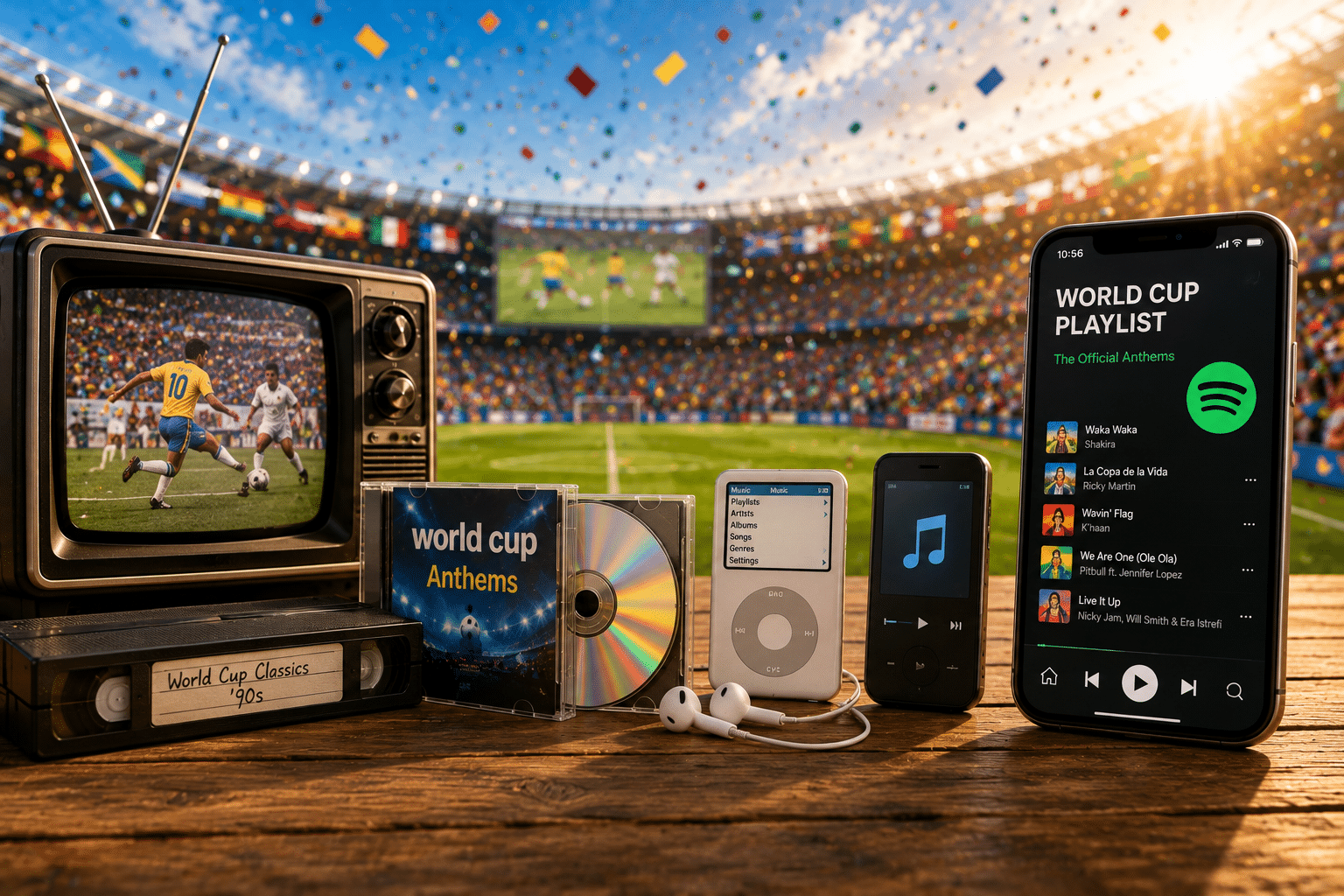
“Waka Waka” and the Digital Breakthrough
The 2010 World Cup in South Africa marked another defining moment.
Shakira’s “Waka Waka (This Time for Africa),” recorded with the South African group Freshlyground, combined international pop appeal with musical influences connected to the African continent. It was performed during the tournament’s closing ceremony and became one of the most recognizable songs associated with any World Cup.
FIFA has described the track as a worldwide chart success and reported that it became the most-streamed World Cup song on Spotify.
Its reach reflected the changing media environment.
By 2010, World Cup music no longer depended exclusively on scheduled television broadcasts or physical record sales. Fans could discover a song through online video, share it on social media, download it, add it to playlists, and return to it whenever they wished.
Music videos also became increasingly important. A successful World Cup video could combine football, choreography, cultural imagery, participating artists, and tournament branding in a form designed for worldwide sharing.
“Waka Waka” demonstrated how World Cup music could exist simultaneously as an official tournament property, a global pop release, an online video phenomenon, and a long-term streaming success.
From One Official Song to a Broader Musical Program
The tournaments that followed continued expanding the musical experience.
“We Are One (Ole Ola),” performed by Pitbull, Jennifer Lopez, and Claudia Leitte, served as the official song of the 2014 World Cup in Brazil. “Live It Up,” featuring Nicky Jam, Will Smith, and Era Istrefi and produced by Diplo, was released for Russia 2018. FIFA’s own historical account places these songs within a tradition that also includes “Un’estate italiana,” “Gloryland,” “La Copa de la Vida,” “Boom,” “The Time of Our Lives,” and “Waka Waka.”
By the 2022 tournament in Qatar, the idea of a single defining release had expanded into a multi-song official soundtrack strategy.
This reflected a fundamental change in how people consume music.
The modern audience is fragmented across countries, languages, genres, platforms, and communities. A single song may still become the best-known anthem, but a broader collection allows a tournament to reach different audiences through different sounds.
It also allows the music program to remain active throughout the tournament cycle. Singles can be released over time, incorporated into promotions, performed at ceremonies, and added to playlists as anticipation grows.
The soundtrack becomes an ongoing campaign rather than a single release.
The Streaming Era Changes Everything
Streaming has transformed the role of music within the World Cup.
In the television era, listeners generally encountered tournament music when broadcasters chose to play it. Today, fans actively search for songs, follow official playlists, save tracks, share releases, watch videos, and create their own tournament soundtracks.
Spotify, Apple Music, YouTube, TikTok, Instagram, and other platforms allow World Cup music to move instantly across borders. Fans no longer need to live in the host country or watch a particu
lar broadcast to hear the tournament’s music.
The distinction between the official soundtrack and fan-created music has also become less rigid.
Official songs now exist alongside national-team songs, supporter chants, remixes, viral audio clips, regional hits, and older recordings rediscovered during the tournament. Argentina’s supporters offered a powerful example during the 2022 World Cup, when “Muchachos” became closely associated with the team and its fans despite developing outside the official tournament soundtrack.
This broader musical environment gives each World Cup several overlapping soundtracks:
- The music officially selected by FIFA
- The songs promoted by broadcasters and sponsors
- The music connected to the host nation
- The songs adopted by individual teams
- The chants created by supporters
- The tracks that become popular through social media
- The older songs revived by tournament memories
Together, these create the full sound of the competition.
FIFA World Cup 2026™: A New Scale for World Cup Music
The FIFA World Cup 2026™ represents another major expansion of the relationship between football and music.
Hosted across Canada, Mexico, and the United States, the tournament spans three countries with enormous musical influence and extraordinary cultural diversity. FIFA Sound developed an extensive official album bringing together artists from different continents and genres to reflect the international scale of the competition. FIFA described the original 18-track release as the most extensive multi-track music project in World Cup history.
The album format recognizes that no single artist, language, or genre could fully represent a tournament of this size.
It also reflects the realities of modern entertainment. The music is not limited to an opening ceremony or a single televised performance. It can accompany the entire World Cup experience through streaming platforms, live events, social media, stadium programming, and personal playlists.
The album’s rollout began with “Lighter” by Jelly Roll and Carín León, a collaboration connecting musical talent associated with the host nations. FIFA made the track available through major streaming services as the first chapter of the broader album campaign.
The program later expanded through additional releases and an official anthem, “DNA,” featuring Andrea Bocelli, David Guetta, Megan Thee Stallion, and EJAE.
This is a long way from the days when a World Cup theme was primarily heard during scheduled television coverage.
The modern official World Cup soundtrack is a global media platform.
The People Behind the Music
The public naturally focuses on the performers, but every major World Cup music project depends on a much larger creative and commercial network.
Behind the recordings are:
- Songwriters
- Composers
- Producers
- Musicians
- Vocalists
- Music publishers
- Record labels
- Artist managers
- Rights administrators
- Licensing professionals
- Distributors
- Streaming platforms
- Live-event production teams
Music publishers play a particularly important role because songs are intellectual property.
Every composition has writers and rights holders. When music is recorded, streamed, broadcast, performed publicly, synchronized with video, included in advertising, or distributed internationally, those rights must be identified, licensed, administered, and protected.
A World Cup music program therefore represents more than artistic creativity. It is also an enormous exercise in international coordination.
The music must travel through different legal territories, media platforms, licensing structures, and commercial relationships. The public hears a polished song. Behind it stands an infrastructure designed to ensure that the work can reach a worldwide audience while the rights of its creators are respected.
Why the Songs Remain After the Matches End
Tournament schedules eventually disappear from daily conversation. Stadiums empty. Temporary signs come down. Players return to their clubs. Broadcasters move on to the next event.
Music remains.
That is the special power of the official World Cup soundtrack.
A song can preserve the emotional atmosphere of an entire tournament in a few minutes. It can remind supporters where they were, whom they watched with, which team they supported, and how they felt when a decisive goal was scored.
World Cup music also reaches people who may not follow football closely. A globally successful song can bring the tournament into homes, cars, celebrations, clubs, and playlists that would otherwise have little connection to the sport.
This is why music is not merely an accessory to the World Cup. It is one of the ways the event becomes part of global culture.
A Shared Language for a Global Tournament
Football and music possess a similar ability to cross borders.
People do not need to speak the same language to understand the tension of a penalty kick, the excitement of a goal, or the energy of a powerful chorus. Both experiences communicate through rhythm, anticipation, release, movement, and emotion.
The FIFA World Cup brings countries together through competition. Its music brings audiences together through shared feeling.
From the early era of host-country themes and television broadcasts to today’s global albums and streaming platforms, the history of FIFA World Cup songs mirrors the evolution of the modern media world.
The methods of distribution have changed. The number of participating artists has grown. The technology has become more sophisticated. The reach is now almost instantaneous.
But the purpose remains remarkably consistent.
World Cup music gives the tournament a voice. It creates anticipation before the opening match, intensifies the experience while the competition is underway, and preserves its memories long after the trophy has been awarded.
That is how music became the soundtrack of the FIFA World Cup—and why it will remain an essential part of the tournament for generations to come.
Experience the Music of the FIFA World Cup 2026™
Explore the songs, artists, and collaborations helping define the sound of the FIFA World Cup 2026™. Look for the Official FIFA World Cup 2026™ Album on Spotify, Apple Music, and other major streaming platforms.
Also read: Champion Music Publishers Salutes the Music and Musicians of the FIFA World Cup 2026™
With musical best wishes,
John Francis Krimsky
Founding President
Champion Music Publishers
This article is intended for general educational and commentary purposes and does not constitute legal advice.