The Writers, Producers, and Publishers Behind 21 of the Greatest Stadium Anthems
The Songwriters Behind the World’s Biggest Sporting Events
By John Francis Krimsky
Founding President, Champion Music Publishers
When thousands of spectators stamp their feet to “We Will Rock You,” chant the melody of “Seven Nation Army,” or recognize the opening guitar of “Thunderstruck,” the performer usually receives most of the public attention.
That is understandable. The recording artist is the voice or face that audiences recognize.
But the emotional power of a great stadium anthem begins somewhere else.
It begins with a songwriter discovering a phrase that thousands of people can sing together. It begins with a composer creating a riff that signals anticipation before a player enters the field. It begins with a producer deciding when the drums should arrive, how large the chorus should sound, and which few seconds of the recording will deliver the greatest impact inside a crowded arena.
After the recording is completed, music publishers, record companies, rights organizations, licensing professionals, broadcasters, event producers, and venue operators help carry it into stadiums, television broadcasts, advertisements, highlight films, streaming platforms, and championship celebrations.
The audience hears one song.
Behind it stands an entire creative and commercial infrastructure.
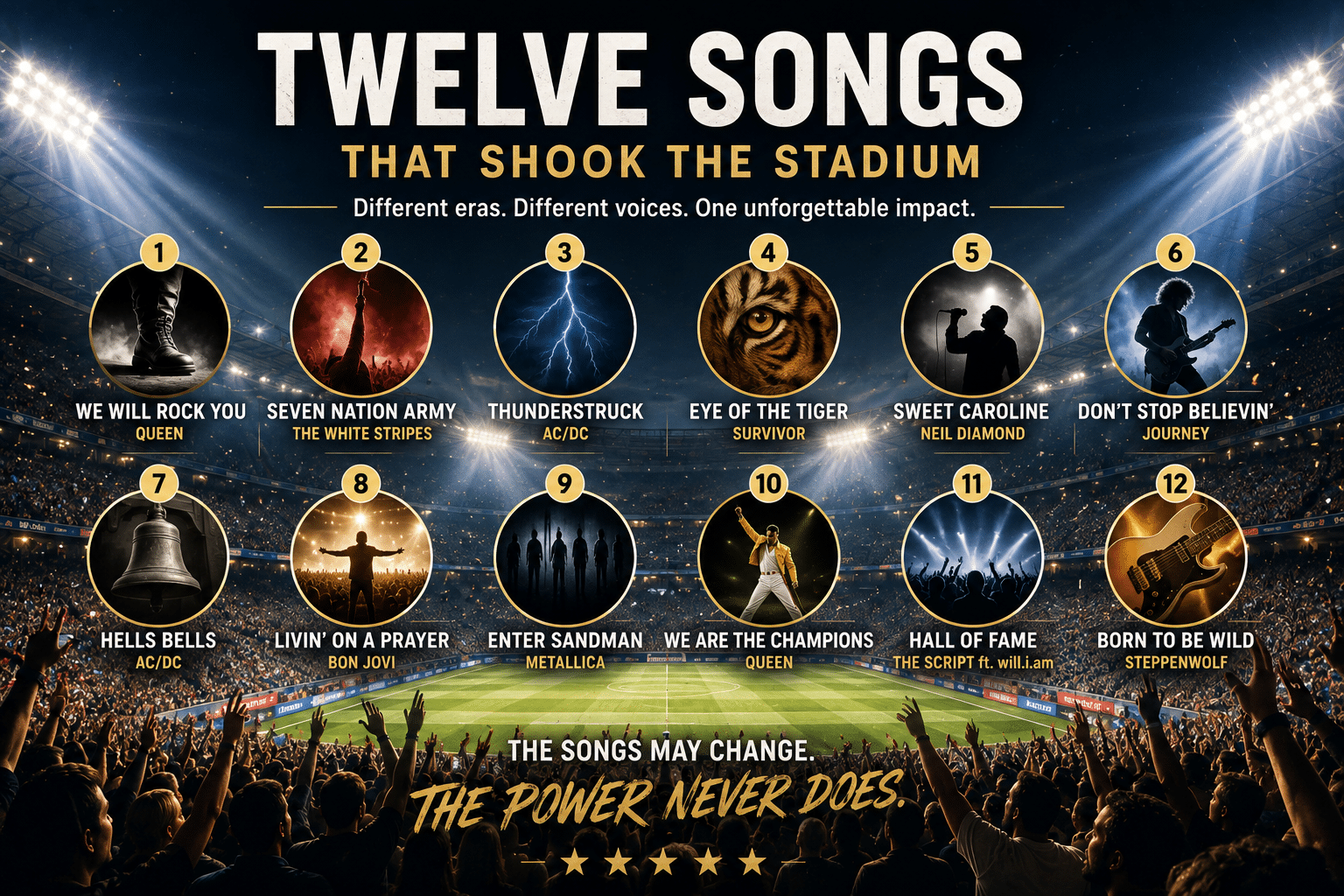
An American Songwriter feature identified 12 especially durable sports anthems, including “Pump Up the Jam,” “Tubthumping,” “Thunderstruck,” “Song 2,” and “We Will Rock You.” Those selections provide an excellent starting point, but the full stadium-music canon extends further—to “Seven Nation Army,” “Crazy Train,” “Eye of the Tiger,” “Enter Sandman,” “Sweet Caroline,” and other recordings that have become inseparable from athletic competition.
Together, these 21 songs reveal how writing, production, performance, publishing, and audience participation turn popular recordings into sporting traditions.
What Turns a Popular Song Into a Stadium Anthem?
Most stadium anthems were not originally written for sports.
“We Will Rock You” was not commissioned for a football game. “Y.M.C.A.” was not created as a baseball tradition. “Sweet Caroline” was not written for the Boston Red Sox, and “Seven Nation Army” was not conceived as an international football chant.
The crowds gave these songs another life.
A recording becomes a stadium anthem when some part of it works unusually well in a large communal setting. That element might be a repeated phrase, a recognizable riff, an instrumental buildup, a physical gesture, or a beat that thousands of people can reproduce together.
The strongest stadium songs usually possess several qualities:
- They are recognizable within seconds.
- They contain a clear rhythmic foundation.
- They create anticipation, defiance, resilience, or celebration.
- They invite clapping, stomping, shouting, singing, or movement.
- They continue to work when played loudly beneath crowd noise.
- They contain a musical moment that can be isolated for an entrance, goal, touchdown, or victory.
- They allow an audience to participate without knowing every lyric.
These qualities begin with creative decisions made by songwriters and producers.
The crowd may ultimately transform the recording, but someone first had to write the phrase, construct the rhythm, arrange the buildup, and make the record powerful enough to command a stadium.
1. “Seven Nation Army” — The White Stripes
Songwriter: Jack White
Producer: Jack White
Few sporting chants have traveled as widely as the melody from “Seven Nation Army.”
Jack White wrote and produced the recording, creating its signature low-register riff by playing a guitar through a pitch-shifting effect. The riff is so simple and clearly shaped that a crowd can reproduce it without instruments or words.
That wordless quality helped the song move across languages and national borders.
Supporters do not need to know the verses. They only need the melody. Once a section of a crowd begins singing it, others can join almost immediately.
The song became particularly important in European football culture before spreading through stadiums around the world. It is now heard at football matches, basketball games, political events, celebrations, and athlete entrances.
“Seven Nation Army” demonstrates that a songwriter does not always need to create an obvious singalong chorus. One unmistakable musical phrase can be enough.
The crowd supplies the rest.
2. “We Will Rock You” — Queen
Songwriter: Brian May
Producers: Queen and Mike Stone
“We Will Rock You” may be the definitive stadium anthem because the audience can perform it without the recording.
Two stomps.
One clap.
Brian May built the composition around a rhythm that requires no instrument, musical training, or shared language. Every person in a stadium can become part of the percussion section.
The song’s greatness lies in its participatory design. Rather than asking the crowd merely to listen, it gives the audience a role in the arrangement.
The verses create confrontation and theatrical tension. The rhythm creates unity. Thousands of separate people begin moving at the same time, producing a sound larger than any individual performer.
“We Will Rock You” is frequently paired with Freddie Mercury’s “We Are the Champions.” Together, the songs provide two sides of the sporting story.
“We Will Rock You” prepares the audience for battle.
“We Are the Champions” provides triumph and release.
3. “Thunderstruck” — AC/DC
Songwriters: Angus Young and Malcolm Young
Producer: Bruce Fairbairn
The opening of “Thunderstruck” creates anticipation before the full band arrives.
Angus Young’s repeating guitar figure sounds like machinery beginning to turn. The vocal chant builds around it, and the arrangement increases in size until the song reaches full force.
This controlled escalation makes the recording ideal for player introductions, team entrances, racing events, highlight reels, and decisive moments.
The song does not release all of its energy immediately.
It makes the audience wait.
That anticipation is a crucial production tool. When every part of a recording is equally loud, nothing feels explosive. “Thunderstruck” creates contrast, allowing the arrival of the drums and full arrangement to feel enormous.
Its title also supplies powerful imagery. Thunder suggests impact, danger, strength, and a force too large to ignore.
That image transfers naturally to athletes and teams preparing to compete.
4. “Crazy Train” — Ozzy Osbourne
Songwriters: Ozzy Osbourne, Randy Rhoads, and Bob Daisley
Original-album production credited to Ozzy Osbourne, Randy Rhoads, Bob Daisley, and Lee Kerslake
“Crazy Train” announces itself with one of rock music’s most recognizable guitar riffs.
Written by Ozzy Osbourne, guitarist Randy Rhoads, and bassist Bob Daisley, the song combines heavy-metal power with a rhythmic structure that feels unusually accessible. Album credits identify the principal band members as producers, with Max Norman serving as engineer.
Its opening works especially well in sports because it communicates urgency before the vocal begins.
A stadium may use only a small portion of a recording. In that environment, the opening seconds are extremely valuable. The song must command attention before the crowd becomes distracted or the live action resumes.
“Crazy Train” accomplishes that instantly.
The title also contributes to its appeal. It suggests speed, unpredictability, intensity, and an experience about to move beyond ordinary control.
Those associations make it a natural fit for football entrances, hockey arenas, wrestling events, racing, and high-energy television sequences.
5. “Welcome to the Jungle” — Guns N’ Roses
Songwriters: Guns N’ Roses
Producer: Mike Clink
“Welcome to the Jungle” transforms an arena into dangerous territory.
The opening guitar creates tension before Axl Rose’s vocal announces that the listener has entered another world. In sports, that idea becomes a declaration of home-field identity.
The home team is effectively telling its opponent:
You are entering our territory now.
The song is credited to the members of Guns N’ Roses, underscoring how band songwriting can emerge from collective development rather than one isolated writer. AllMusic’s credits identify the group as composers, while Appetite for Destruction was produced by Mike Clink.
Its sports value comes from atmosphere. The song does not merely create excitement. It creates intimidation.
That distinction is important.
Some stadium songs invite everyone to celebrate. Others are directed toward the opponent. “Welcome to the Jungle” tells visiting players that they have entered a place where the crowd, environment, and home team are aligned against them.
6. “Eye of the Tiger” — Survivor
Songwriters and Producers: Jim Peterik and Frankie Sullivan
Unlike many stadium standards, “Eye of the Tiger” was written specifically for an athletic story.
Sylvester Stallone approached Survivor to create music for Rocky III. Songwriters Jim Peterik and Frankie Sullivan developed a guitar-driven composition whose rhythm could match the movement and impact of the boxing sequences. They also produced the recording.
The title came from a phrase associated with Rocky Balboa’s need to regain his competitive hunger.
That idea gave the song a life far beyond the film.
“Eye of the Tiger” became a musical symbol of preparation, discipline, determination, and the willingness to continue when success is uncertain.
Its riff feels like physical movement. It suggests steps, punches, repetitions, and forward progress.
The song demonstrates the commercial potential of successful synchronization. A composition written for a specific motion picture became an international hit, a fitness standard, a sports anthem, and a permanent part of popular culture.
One strategic placement created decades of additional value for the songwriters, publisher, recording artist, label, and film.
7. “Jump Around” — House of Pain
Songwriter and Producer: DJ Muggs
Additional writing credit: Erik Schrody
“Jump Around” does exactly what an effective stadium song should do: it gives the audience a direct physical instruction.
The title is short, memorable, and active. The recording’s opening horn sample, forceful beat, and repeated command create an immediate communal response.
Crowds do not have to interpret the song.
They know what to do.
That simplicity helped “Jump Around” become especially valuable in college sports. Its most famous stadium association may be the University of Wisconsin, where students and fans traditionally jump together between the third and fourth quarters of home football games.
In that setting, the song is no longer merely played over the public-address system. It becomes a physical event that causes the stadium itself to move.
The writer and producer created the possibility.
The audience turned it into a tradition.
8. “Enter Sandman” — Metallica
Songwriters: James Hetfield, Lars Ulrich, and Kirk Hammett
Producer: Bob Rock, with James Hetfield and Lars Ulrich
The opening of “Enter Sandman” is built for an entrance.
The guitar begins quietly and ominously. Additional elements arrive gradually. The tension grows until the complete riff takes over.
James Hetfield, Lars Ulrich, and Kirk Hammett share the composition credit, while Bob Rock produced the recording with Hetfield and Ulrich.
The song’s slow construction allows athletes and teams to time their arrival to the growing intensity.
That quality helped make it one of the most effective entrance songs in sports. It has become especially associated with Virginia Tech football, where the team enters Lane Stadium as the crowd jumps to the recording.
It has also been used famously in baseball, including as the entrance music for relief pitcher Mariano Rivera.
“Enter Sandman” shows how production can shape a ritual. The buildup supplies time for anticipation. The full riff provides the moment of arrival.
The music and physical entrance become one coordinated performance.
9. “Song 2” — Blur
Songwriters: Damon Albarn, Graham Coxon, Alex James, and Dave Rowntree
Producers: Stephen Street and Blur
Many sports fans know only one part of “Song 2.”
That is enough.
The explosive “woo-hoo” arrives with distorted guitars and a sudden increase in volume. Those few seconds can accompany a goal, player entrance, replay, or celebration without requiring the audience to know the verses.
All four members of Blur share the songwriting credit, with Stephen Street and the band producing the recording.
Its power comes from contrast.
The verses are comparatively restrained. The chorus erupts. That difference gives broadcasters and stadium operators a ready-made moment of release.
“Song 2” also shows that the original artistic intention does not determine a recording’s entire future. The track was partly an exaggerated response to the loud alternative-rock style of its period.
The qualities that made it exaggerated also made it perfect for sports.
10. “Don’t Stop Believin’” — Journey
Songwriters: Jonathan Cain, Steve Perry, and Neal Schon
Producers: Kevin Elson and Mike Stone
“Don’t Stop Believin’” is not an intimidation song.
It is a collective statement of hope.
Jonathan Cain, Steve Perry, and Neal Schon wrote the composition, while Kevin Elson and Mike Stone produced Journey’s original recording.
Its long build is unusual. The title and true chorus do not arrive until late in the song. By the time they appear, the audience has been waiting for the emotional release.
In a stadium, that delay becomes an advantage. Fans recognize the piano introduction, sing the verses, and anticipate the section they know is coming.
The message is flexible enough to serve many teams and cities. It can be played when a comeback remains possible, when a season is reaching its conclusion, or when supporters simply want to sing together.
Detroit sports audiences have formed a particularly strong connection with the reference to “south Detroit,” but the song’s emotional reach extends far beyond one region.
It turns perseverance into a communal chorus.
11. “Start Me Up” — The Rolling Stones
Songwriters: Mick Jagger and Keith Richards
Producers: The Glimmer Twins
The title of “Start Me Up” makes its sporting function clear.
It is music for the beginning of something.
Mick Jagger and Keith Richards wrote the song and produced it under their long-used production name, the Glimmer Twins. The recording is driven by one of Richards’ most recognizable guitar openings.
Like the finest stadium riffs, it makes an impact before the lyric develops.
The phrase “start me up” is direct, positive, and active. It works for opening broadcasts, beginning a game, launching a season, introducing a team, or signaling that a crowd should become engaged.
The song’s durability also reflects the importance of catalog value.
A recording does not need to be new to remain commercially useful. An older composition can continue generating public performances, licensing opportunities, broadcast uses, advertising placements, and renewed streaming activity decades after its original release.
A powerful opening riff does not expire.
12. “Sweet Caroline” — Neil Diamond
Songwriter: Neil Diamond
Producers: Tommy Cogbill, Tom Catalano, and Neil Diamond
“Sweet Caroline” is one of the clearest examples of a song acquiring a sporting identity long after its creation.
Neil Diamond did not write it for the Boston Red Sox, English football supporters, boxing audiences, or international celebrations. The crowds created those associations.
Its stadium power is concentrated in the spaces around the chorus.
The audience adds its own responses. Those additions are not necessarily part of the original lyric, but they have become essential to the public performance.
That development demonstrates that a crowd can informally rearrange a song.
Listeners decide where to clap, when to shout, and which instrumental spaces should receive a vocal response. Over repeated performances, those decisions become tradition.
“Sweet Caroline” is effective because it is warm rather than aggressive. It creates companionship, nostalgia, and a sense that everyone in the venue knows the same ritual.
Not every stadium song needs to intimidate an opponent.
Some exist simply to make strangers feel like neighbors.
13. “Pump Up the Jam” — Technotronic
Songwriters: Manuela Kamosi and Thomas De Quincey
Producer: Thomas De Quincey
“Pump Up the Jam” communicates its purpose before the listener needs an explanation.
The beat arrives immediately. The title is a command. It tells the sound system, players, and audience that the energy is about to increase.
The song’s efficiency is part of its genius.
“Pump up the jam” is short enough to remember, physical enough to inspire movement, and flexible enough to work in clubs, exercise settings, television promotions, and sports arenas.
A great sports anthem does not always need to describe victory.
Sometimes it only needs to change the energy in the building.
14. “Let’s Get It Started” — The Black Eyed Peas
Songwriters: William Adams, Allan Pineda, Jaime Gomez, George Pajon Jr., Terence Yoshiaki, and Michael Fratantuno
Producer: will.i.am
The title of “Let’s Get It Started” sounds as though it was written specifically for the opening of a major event.
It signals the transition from waiting to action.
The song was connected with promotion surrounding the 2004 NBA Playoffs, helping establish it as a natural fit for sports audiences.
Its strength comes from structure and escalation. The beat creates forward movement while the central phrase functions as an invitation to players and spectators alike.
The collaborative credits also remind us that major recordings frequently involve several writers and musicians.
The public may hear one unified track.
Behind it may be multiple creative contributors shaping the lyric, harmony, instrumentation, arrangement, and production.
15. “Tubthumping” — Chumbawamba
Songwriters and Producers: Chumbawamba
“I get knocked down, but I get up again” may be one of the most naturally athletic ideas ever placed in a popular chorus.
It can describe a player recovering from defeat, a team returning after a difficult season, or a supporter remaining loyal through disappointment.
The recording was written and produced collectively by Chumbawamba.
Its chorus is ideal for communal singing. The melodic range is manageable, the message is clear, and the words repeat.
That matters because a stadium anthem must survive the crowd.
The voices will not be perfectly trained or precisely synchronized. The composition must remain recognizable anyway.
“Tubthumping” does more than survive mass participation.
The crowd completes it.
16. “Y.M.C.A.” — Village People
Songwriters: Jacques Morali and Victor Willis
Producer: Jacques Morali
“Y.M.C.A.” possesses one of the rarest qualities in popular music: the audience can participate without singing a word.
The arm movements spelling its title turned the recording into a physical ritual.
Jacques Morali and Victor Willis wrote the song, with Morali producing the recording. Its durability begins with an unusually effective combination of musical and visual ideas.
The song offers:
- A title made from four recognizable letters
- A steady dance beat
- A repeated chorus
- Physical audience participation
- A mood of uncomplicated celebration
- Accessibility across ages and languages
The song also provides a valuable lesson about intellectual property. Authorship is not merely a ceremonial credit. It can determine ownership, control, royalty participation, and the ability to reclaim rights many years later.
17. “Whoomp! (There It Is)” — Tag Team
Songwriters and Producers: Cecil Glenn and Stephen Gibson
Few phrases fit a scoring play as naturally as “Whoomp! There it is.”
A touchdown is completed. A goal is scored. A home run clears the wall.
The phrase arrives as an immediate musical reaction.
Cecil Glenn and Stephen Gibson created and performed the recording as Tag Team. Its central idea functions almost like musical punctuation.
The record also relies on call and response.
The lead voice makes the call. The audience supplies the answer.
That structure existed in community, religious, and musical traditions long before modern sports arenas. Tag Team translated it into a commercial recording that can be activated instantly whenever a crowd needs to celebrate.
18. “Rock and Roll Part 2” — Gary Glitter
Songwriters: Gary Glitter and Mike Leander
Producer: Mike Leander
“Rock and Roll Part 2” became a sports standard because of its heavy beat, simple instrumental pattern, and wordless crowd response.
However, its place in stadium culture requires an important qualification.
The recording’s long sporting association has been overshadowed by Gary Glitter’s criminal convictions. Many teams and venues stopped using the song, demonstrating that music selection does not occur in a cultural vacuum.
A venue may possess the legal ability to use a recording under an appropriate license and still determine that playing it conflicts with the organization’s standards or audience expectations.
This is an important lesson for music supervisors, teams, leagues, and sponsors.
A song must be evaluated not only for its musical impact, but for the public associations, reputational risks, and values surrounding its use.
19. “Sandstorm” — Darude
Composer and Producer: Ville Virtanen
Production collaboration: Jaakko Salovaara
“Sandstorm” proves that a stadium anthem does not need lyrics.
The recording creates emotion entirely through rhythm, repetition, acceleration, tension, and release.
That absence of words is an advantage in international sport. There is nothing to translate and no verbal narrative competing with the action.
The track can accompany team entrances, timeouts, rallies, highlights, and crowd buildups in almost any country.
In electronic music, production and composition are often inseparable.
The sounds, pacing, drum programming, melodic repetition, and control of intensity are not decorative additions. They are the central creative work.
20. “I Like to Move It” — Reel 2 Real Featuring The Mad Stuntman
Songwriters: Erick Morillo and Mark Quashie
Producer: Erick Morillo
The strength of “I Like to Move It” is contained in the title.
Movement is the entire point.
Erick Morillo created the dance production while Mark Quashie, performing as the Mad Stuntman, gave the recording its distinctive vocal identity.
The song works in stadiums because its hook is simultaneously verbal and physical.
The audience hears the instruction and responds through movement.
Repetition is sometimes treated as a lack of sophistication. In communal music, repetition is often the source of effectiveness.
A crowd needs clarity. People must recognize the phrase, predict its return, and participate without rehearsal.
21. “Gonna Make You Sweat (Everybody Dance Now)” — C+C Music Factory
Songwriters: Robert Clivillés and Freedom Williams
Producers: Robert Clivillés and David Cole
Few vocal openings are more immediately recognizable than “Everybody dance now.”
The phrase is direct, inclusive, and impossible to misunderstand.
Robert Clivillés and Freedom Williams received the principal songwriting credit, while Clivillés and David Cole created the recording’s powerful dance production.
The track also helps explain the difference between a composition and a sound recording.
The song—the underlying music and lyrics—is a distinct copyrighted work from the particular recorded performance. Songwriters and publishers may control interests in the composition, while performers, producers, and record companies may hold interests in the master recording.
A stadium audience hears one unified piece of music.
The rights structure may involve two separate works and several different owners.
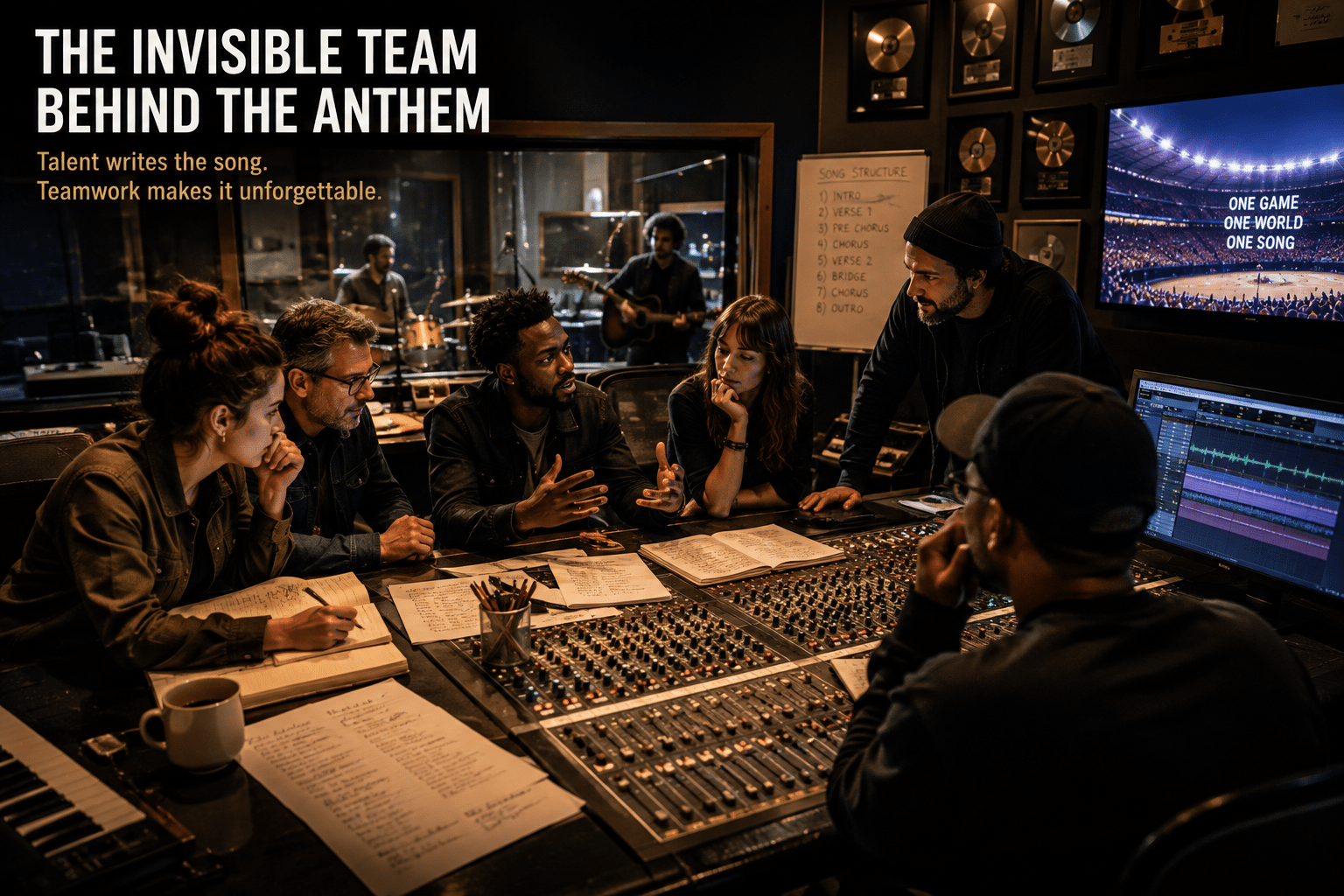
Why the Songwriter Is Often Invisible
At a major sporting event, the audience sees the athlete and hears the recording artist.
The songwriter may be nowhere in sight.
Yet the songwriter may have created the part everyone remembers:
- The phrase the crowd shouts
- The melody supporters sing
- The riff that announces a player’s entrance
- The rhythm the audience reproduces
- The emotional idea associated with perseverance or victory
- The chorus that survives for generations
Popular music is generally marketed under the performer’s name. That can lead audiences to assume that the singer wrote every lyric, composed every musical element, and produced the recording.
Sometimes that is true.
Often it is not.
Credits matter because they identify the creators of the intellectual property at the center of the experience.
They also help determine who receives royalties when the composition is performed, streamed, broadcast, reproduced, licensed, or synchronized with visual content.
The songwriter may be invisible in the stadium.
The songwriter is not invisible in the chain of rights.
What the Producer Contributes
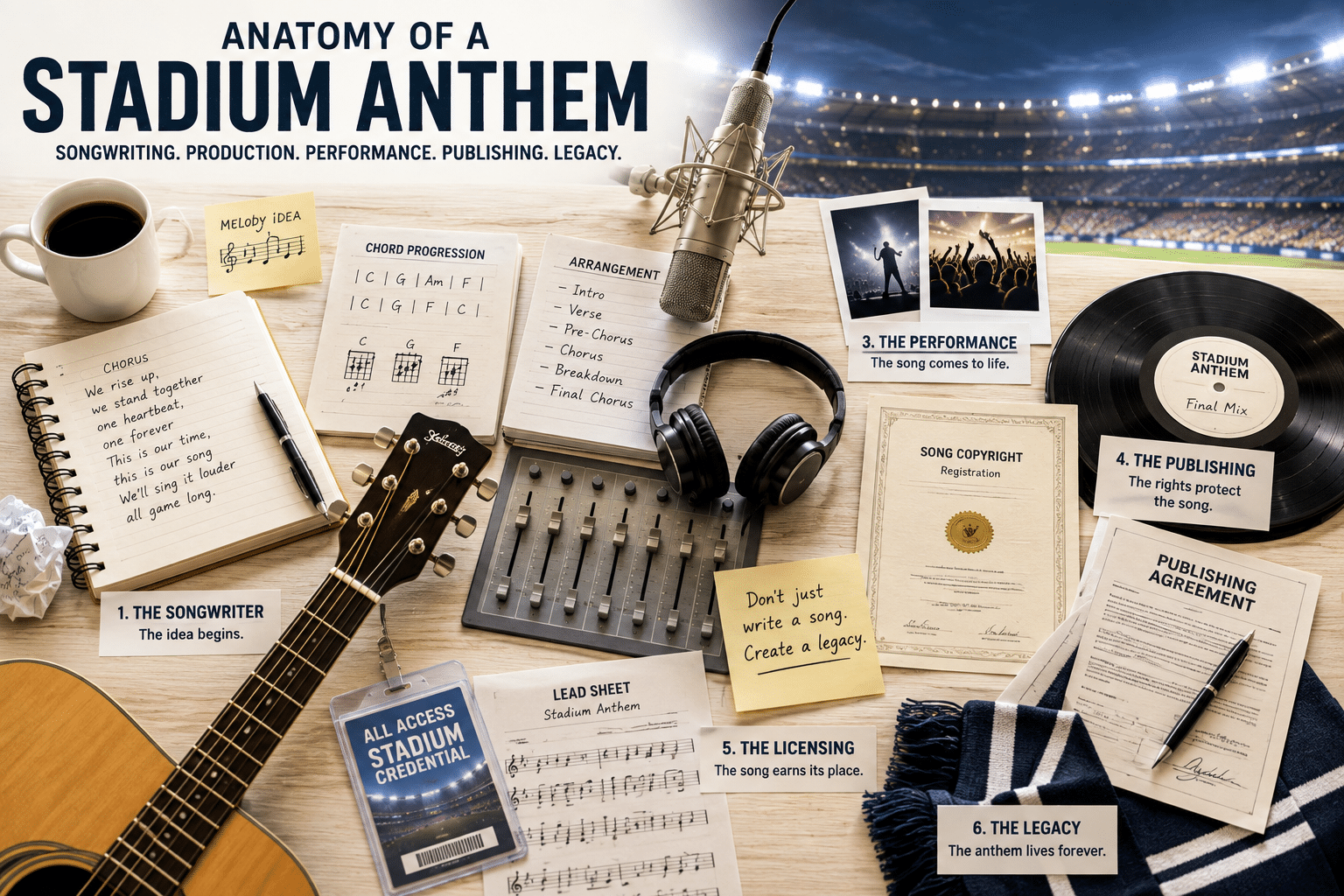
If the songwriter creates the blueprint, the producer helps construct the building.
A producer may shape the arrangement, select sounds, guide performances, program instruments, restructure sections, edit vocals, manage the recording process, or determine the overall scale of the finished master.
In stadium music, sonic impact matters.
The recording may be played through an enormous sound system, beneath crowd noise, during a brief stoppage, or behind rapidly changing broadcast images.
The track must communicate quickly.
The producer helps determine:
- The size and impact of the drums
- The clarity of the central hook
- The contrast between buildup and release
- The intensity of the bass and guitars
- The placement of the vocal
- The exact moment the recording reaches full force
- Which sections can be used for entrances and celebrations
A strong composition can be weakened by an ineffective recording.
A great producer ensures that the song’s strongest idea can be felt.
What the Music Publisher Does
The publisher’s work generally begins where public recognition ends.
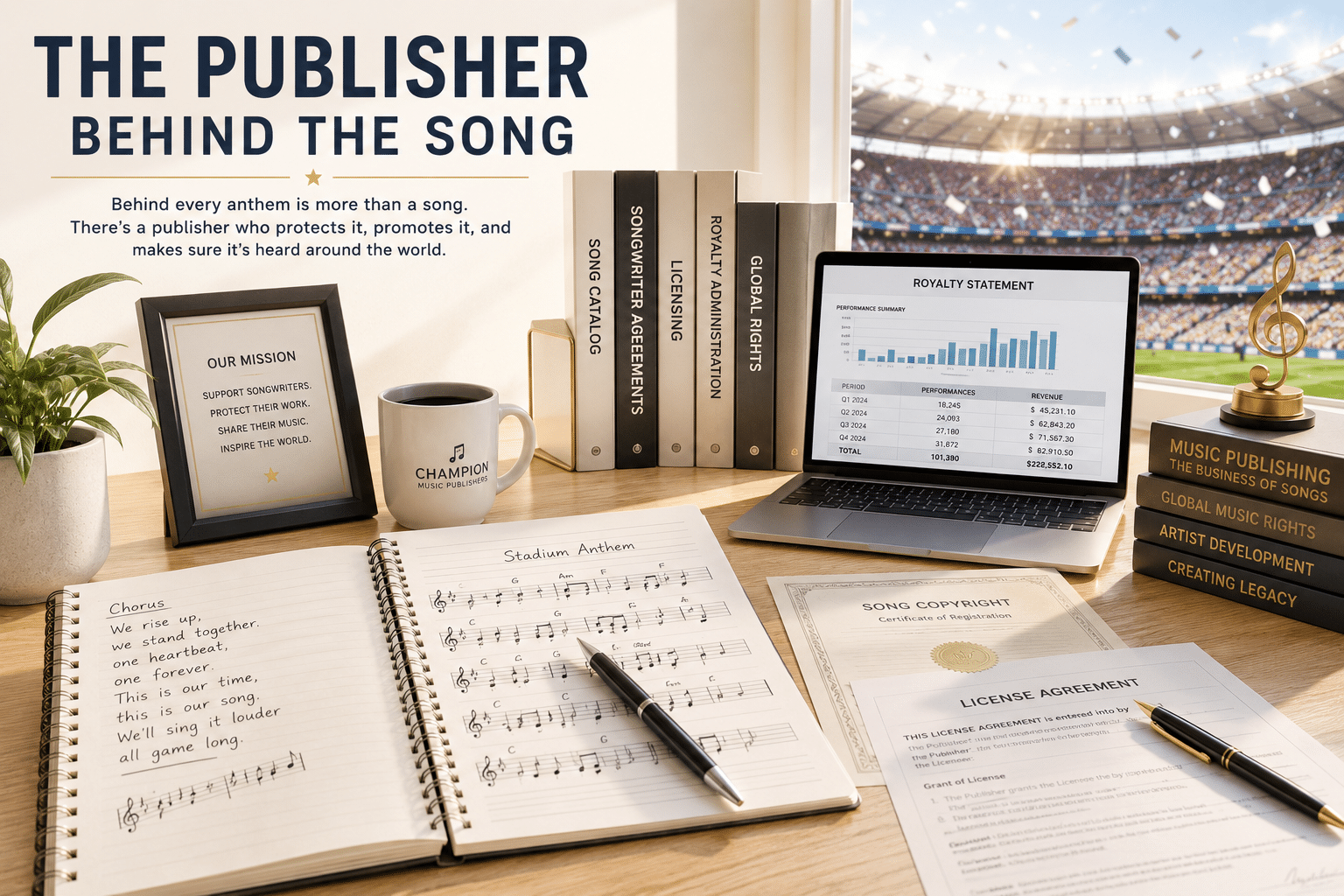
A music publisher administers songs as intellectual property. Depending on the agreement, the publisher may register compositions, document ownership, issue or negotiate licenses, collect royalties, resolve claims, seek placements, protect rights, and help connect music with commercial opportunities.
The publisher is not simply storing a copyright.
A serious publisher works to keep the composition active and valuable.
In sports, music may be used in:
- Stadium and arena presentations
- Television and radio broadcasts
- Team introductions
- Promotional campaigns
- Highlight films
- Sponsor advertising
- Social-media videos
- Documentaries
- Video games
- Streaming productions
- Opening and closing ceremonies
Some public performances may be covered by licenses obtained through performing-rights organizations. Other uses, especially advertising and synchronization with video, may require additional permission from the relevant composition and recording owners.
Playing a Song Is Not the Same as Owning It
Music can feel public because it is familiar.
Familiarity does not eliminate ownership.
A recording played at a sporting event can involve two principal copyrighted works:
- The underlying musical composition
- The particular sound recording
The composition consists of the music and lyrics. The sound recording captures a specific performed and produced version.
This distinction explains why one license does not necessarily cover every possible use.
Playing a recording inside a venue differs from placing it beneath a television commercial. Synchronizing it with a highlight video differs from performing a new version live. Streaming an event may involve considerations beyond those associated with the in-person audience.
Experienced publishers, performing-rights organizations, labels, attorneys, and licensing professionals help sports organizations use music legally while ensuring that creators and rights holders are compensated.
The Crowd Gives the Song Another Meaning
The songwriter writes the composition.
The producer creates the recording.
The publisher helps protect and circulate the work.
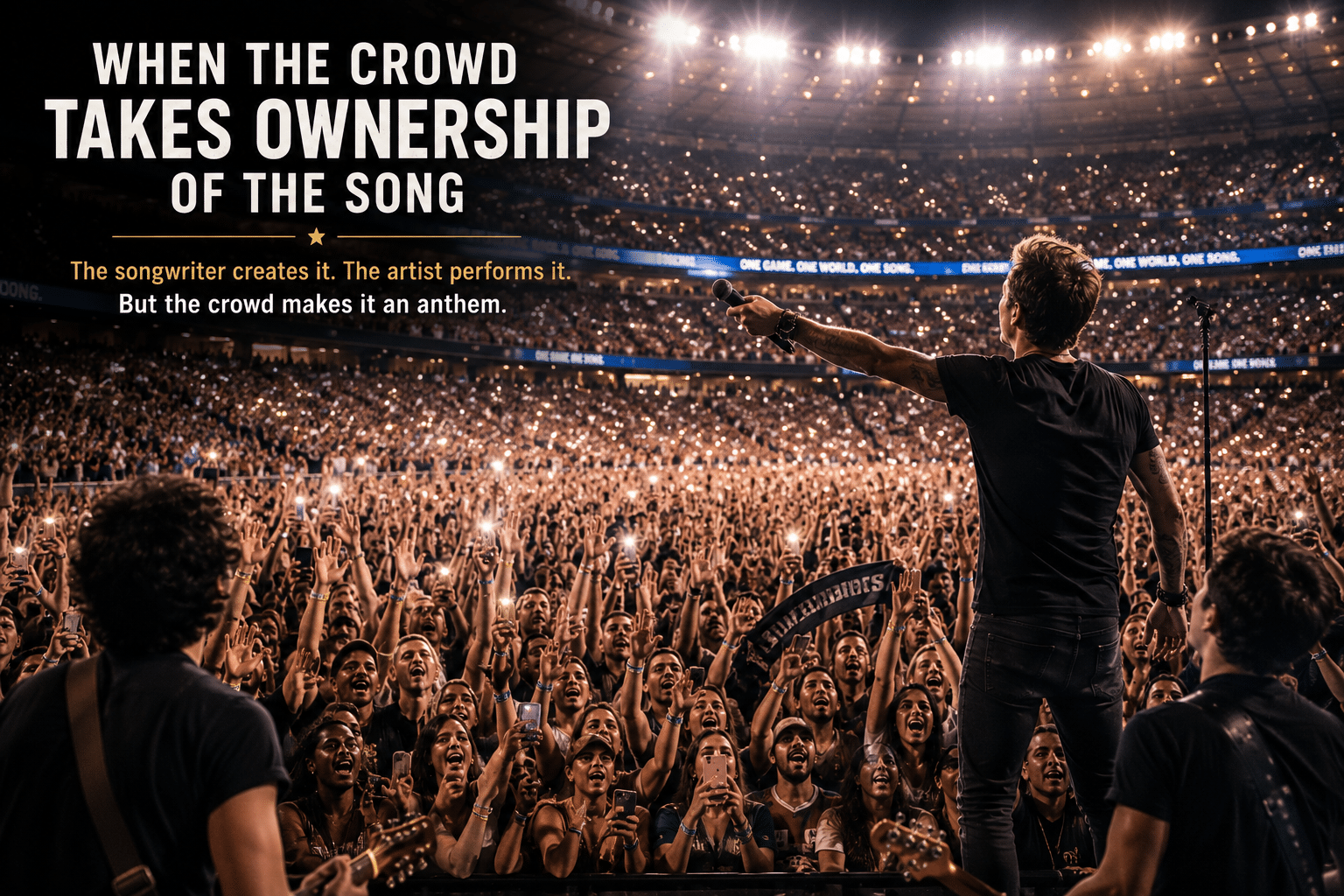
Then the crowd changes it.
Once thousands of supporters begin using a song to celebrate a team, the recording acquires associations that may never have been anticipated in the studio.
“Seven Nation Army” becomes a wordless international football chant.
“Crazy Train” becomes an entrance signal.
“Eye of the Tiger” becomes a symbol of training and perseverance.
“Enter Sandman” becomes a ritual of intimidation.
“Jump Around” causes an entire college stadium to move.
“Sweet Caroline” becomes a communal singalong.
“We Will Rock You” turns the crowd into the percussion section.
The composition remains legally owned.
Culturally, it becomes shared.
Behind Every Stadium Anthem Is a Chain of Creativity
The next time a familiar anthem shakes a stadium, listen beyond the performer.
Listen for the phrase someone had to write.
Listen for the riff someone had to compose.
Listen for the buildup someone had to arrange.
Listen for the drums, vocal placement, guitar entrance, or electronic drop someone had to produce.
Remember that the composition had to be registered, administered, licensed, delivered, and protected.
The most famous stadium anthems sound inevitable today, but none of them began that way. Each started as an idea that had not yet been tested by a crowd.
A songwriter found the words or melody.
A producer made the recording powerful enough to fill a stadium.
A publisher helped give the work an organized commercial life.
Then the audience made it part of sporting history.
The singer may stand at the front of the stage.
But behind every song that moves a stadium are creators and stewards whose names deserve to be heard.
Recognizing the People Behind the Music
Champion Music Publishers salutes the songwriters, composers, producers, performers, publishers, rights administrators, and licensing professionals whose work gives the world’s greatest sporting events their sound.
Their contributions remind us that music is not merely background entertainment.
It is creative work.
It is intellectual property.
It is a business asset.
And when the right song meets the right crowd, it becomes part of our shared cultural memory.
With musical best wishes,
John Francis Krimsky
Founding President
Champion Music Publishers
This article is intended for general educational and commentary purposes and does not constitute legal advice.